
Essay AI Deployment
Getting a Legal AI Agent From Pilot to Production
Five structural decisions on ownership, scope, and oversight must precede any live legal agent.
Getting a legal AI agent from pilot to production requires more than a capable model. It requires an organization that can govern the agent’s actions, assign responsibility, detect failures, and demonstrate value. The decisions about ownership, scope, evaluation, and oversight must precede live work. Otherwise, a successful pilot proves only that the agent can perform under controlled conditions.
Why legal AI agents stall between pilot and production
Having an agent is not the same as having one that works. A pilot can succeed on curated data in a sandbox without establishing whether the agent can reach live systems, interpret conflicting records, or recover when execution fails. Production asks a different question. It tests whether the organization can operate the agent as an accountable part of a workflow.
That gap concerns data access, identity, lifecycle management, and governance. NTT DATA’s November 2026 paper connects greater autonomy with greater operational, security, and governance risk, making readiness assessment a prerequisite. Workflow ownership and permission boundaries are organizational decisions that a pilot can leave unresolved even while its outputs appear convincing.
Legal work makes those omissions especially consequential. An agent acting on an outdated filing, a superseded order, or a misread docket entry creates exposure to professional liability. The failure may lie in establishing which document is current, who can authorize an action, or who must intervene when the agent encounters uncertainty.
The five structural conditions that separate production-ready legal agents from stalled pilots
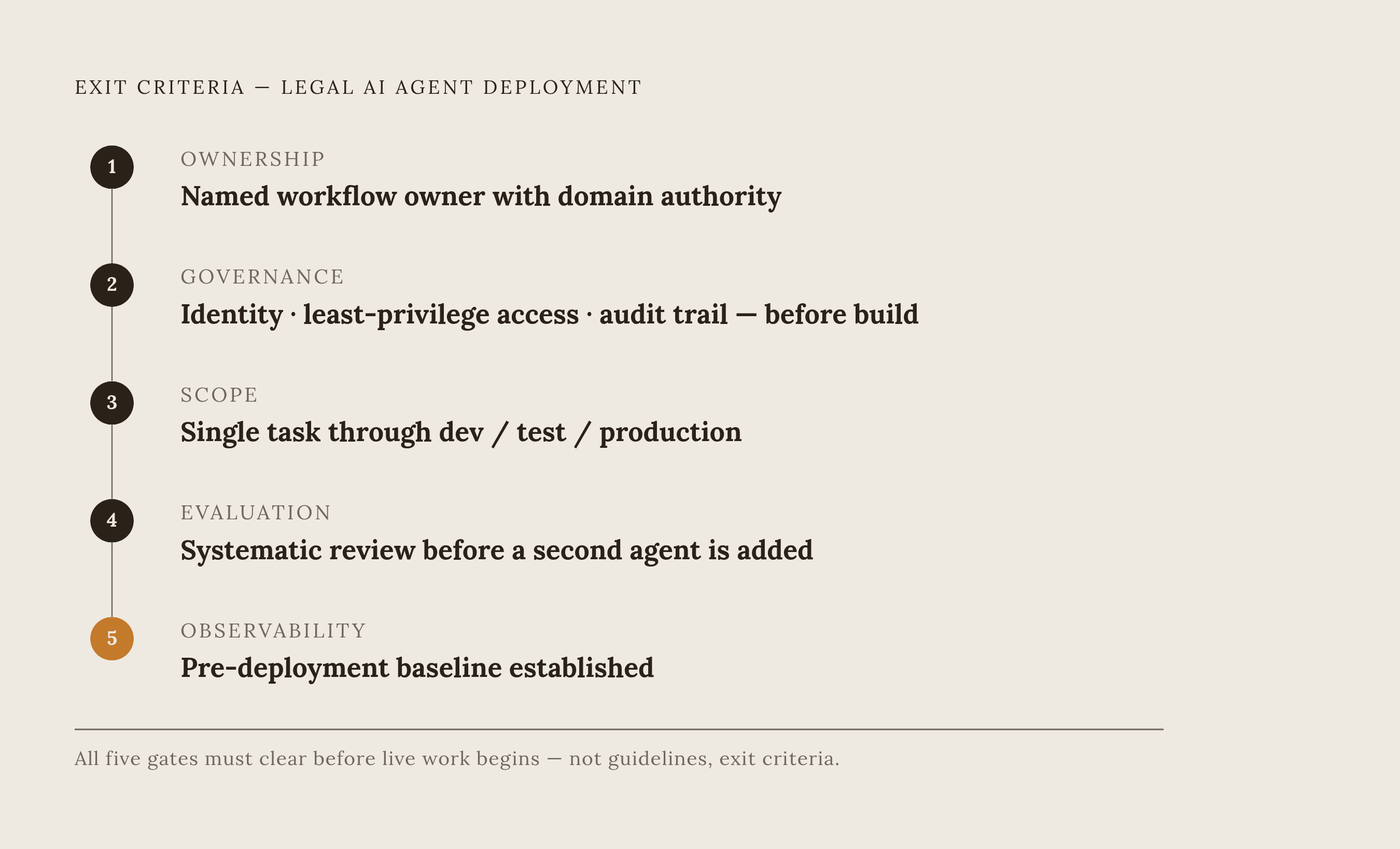
The first decision is who owns the workflow. A named person must be accountable for the agent’s performance as part of a defined job responsibility, rather than leaving responsibility with the development team, IT, or a business unit collectively. In legal work, that person needs enough domain authority to decide what to do when edge cases arise. Ownership must be actionable at the moment of failure. The Enterprise Agent Deployment Maturity Model identifies unclear ownership as one of five root causes that together account for most scaling failures.
The second decision establishes governance before the agent is built. Identity, least-privilege access, data-loss controls, and an audit trail must be in place before the agent first acts in production. Otherwise, security review becomes the point at which the organization discovers that its working prototype cannot be approved. Access to real systems of record also requires solved authentication.
The third decision limits the initial scope. A single, well-defined task gives the owner a bounded workflow whose reliability can be assessed in production. A broad assistant combines responsibilities before the organization has learned how to operate even one reliably. The agent must also move through a dev/test/production lifecycle so that changes do not bypass the controls established for its initial release.
The fourth decision establishes systematic evaluation before a second agent is introduced. Asking the builders whether their agent works is not an evaluation method that scales across departments. The fifth decision establishes observability and a pre-deployment baseline before launch, so that task completion and failures can be explained. These conditions are exit criteria. In legal work, the governance condition requires particular scrutiny because compliance sensitivity constrains what the agent can be allowed to do.
What governance must cover in a legal context specifically
Tsinghua University’s LLM Agent Readiness Assessment matrix, known as LARA, scores tasks on five dimensions and gives Compliance Sensitivity a fixed weight of 1.5×. A three-round Delphi study determined that weighting, the highest assigned to any dimension. A task’s compliance profile therefore still matters even when it scores well on the other dimensions. For legal deployment, this means an agent must be able to complete a task under defensible controls.
Identity is the starting point for those controls. Every agent session must map to a named human identity, because attributing an action only to an AI agent does not establish professional responsibility. Permissions must then match the task. An agent that reviews contracts does not need write access to the docket management system, even if the platform can give it that access.
Consequential decisions also require explicit human checkpoints. Bounded autonomy allows routine execution while routing decisions with professional or liability consequences to a named person. Rollback procedures must be written down before deployment, and model upgrades need change management and evaluation of how the agent behaves in production. Replacing the underlying model is a production change. Treating it as routine maintenance would skip the testing that the system itself is expected to undergo.
The regulatory references require equal precision. The European Commission states that enforcement powers apply from August 2, 2026, when certain EU AI Act provisions become enforceable, rather than all provisions becoming enforceable at once. ABA Formal Opinion 512 provides advisory guidance without binding statutory or regulatory force or prescribed penalties. These references establish a legal and professional floor. The Agentic AI Institute’s 2026 report states that 60% of surveyed firms lack formal governance, illustrating the gap between adoption and the controls needed to make deployment accountable.
That gap concerns data access, identity, lifecycle management, and governance.
How Harvey's production deployment illustrates these conditions working together
Harvey’s workflow agents illustrate how bounded autonomy can be designed into legal work. Human-in-the-loop checkpoints keep lawyers in control of consequential decisions while agents carry out routine steps without a review of each action. That distinction defines the division of responsibility.
The scope is also organized around defined work. Contract review, document editing, legal research, and motion drafting are identifiable workflow types rather than an unrestricted remit for a general-purpose assistant. Harvey’s Workflow Builder reflects that narrow-scope-first approach. Defined workflows give evaluation and monitoring a specific object, because performance can be judged against the work the agent was assigned to complete.
The August release of Harvey II enabled the Harvey Agent to take on more complex work across the platform, while a major October 2026 update expanded connected search and strengthened legal research and motion drafting. The sequence illustrates expansion after narrower production use. Model capability still matters, but here it grows within a workflow structure that is already in place.
The case’s checkpoints demonstrate governance and human control, while its workflow boundaries show how scope can remain explicit as capabilities grow. Those features make ownership, evaluation, and observability concrete questions for each workflow. They do not, by themselves, establish another organization’s named owner, baseline, or monitoring arrangements. A legal department deploying a generic LLM with broad access still has to make those decisions.
What the readiness assessment process looks like in practice
For teams preparing a deployment, the assessment begins by inventorying candidate workflows and documenting baseline evidence. The first stage records what each workflow produces, its cost, and its error rate. In legal work, the output must be defined closely enough to distinguish completion from an acceptable result. This evidence becomes the reference against which the agent’s contribution can later be assessed.
The second stage screens candidates for value, feasibility, risk, and ownership. A workflow should have a named owner before it moves ahead, even if much of the work seems open to automation. That screen must cover legal authority because the owner needs to be able to decide what to do with exceptions that have serious consequences. The third stage checks data quality, permissions, and whether integrations are stable. A clean pilot export cannot show whether live records arrive on time, agree across systems, or reflect the current filing or order.
The fourth stage sets out the controls for evaluation and governance. It defines acceptable performance, how that performance will be measured, and where human intervention is required. LARA’s compliance weighting gives legal teams a reason to look more closely at compliance-sensitive workflows at this stage. The assessment tests how well the controls work. Identity, security architecture, permission boundaries, and auditability must support the particular work proposed.
The fifth stage estimates delivery and operating requirements, including monitoring, incident response, model upgrades, and ongoing operating cost. Build cost alone is an incomplete estimate. The sixth stage ranks the portfolio and produces a remediation roadmap showing which workflows can advance and what must change for the others. The assessment also produces a compliance record relevant to professional duties addressed by the ABA opinion and applicable auditability requirements under the Act. Its practical outputs are therefore a deployment decision, documented gaps, and a record of the controls on which that decision depends.
Observability and human oversight as ongoing production requirements, not launch-day checkboxes
Production changes the role of evaluation from a release decision to a continuing operating responsibility. NTT DATA’s framework measures operational trust through task success rate, constraint adherence, intervention rate, and execution complexity. These signals show whether the agent remains within its designed boundaries. They serve as operating signals as well as retrospective reporting. Their value depends on having defined who reviews them and when intervention is required.
Non-deterministic output makes that responsibility especially hard to meet in legal work. An agent can behave differently on the same input, weakening the assumption that a successful test establishes predictable future behavior. Observability exposes those differences so that they can be assessed before they develop into liability events. Data-freshness monitoring addresses a related but distinct risk. Acting on outdated information can reflect a failure in the operating model even when the agent processes the information correctly.
A rising intervention rate is an early warning requiring examination, rather than a self-explanatory verdict that the agent has failed. Escalation arrangements must identify which decisions go to a human, who that person is, and what the agent does while waiting. An agent that continues autonomously when its required escalation path is unavailable is not production-ready.
The maturity model places SLAs with internal clients at Stage 3 production deployment, where teams make clear commitments to service levels in place of promises to do their best. A dedicated AI operations function, distinct from IT and the business unit, makes monitoring sustainable by owning evaluation frameworks, production monitoring, and incident response with a budget and mandate. This operational responsibility complements the legal workflow owner’s authority. Observability makes accountability possible by showing behavior that would otherwise go unexplained, and legal work requires that accountability.
Measuring whether a production legal AI agent is delivering what it was deployed to deliver
Production measurement must connect operational behavior to the reason the agent was deployed. Task completion rate counts outputs that meet defined acceptance criteria. Cycle time compares the targeted workflow with its documented baseline, whether that workflow concerns contract review, motion drafting, or invoice routing. A faster process that requires substantial correction has not demonstrated the same benefit as one that produces acceptable work with less intervention.
Intervention rate therefore serves both trust and efficiency measurement. It shows how often a human must correct or override the agent, while incident rate and severity distinguish routine oversight from failures involving outdated information, misread documents, or rollback. Operating cost per task must cover monitoring, model upgrades, and human oversight as well as the cost of the build. Together, these measures make the economics visible. Their records also provide evidence that regulators, bar associations, and clients can inspect.
For legal teams building the business case, the practical requirement is to define success and document the baseline before the pilot begins. Retroactive baselines invite dispute over what improved and what the agent actually contributed. Per-phase cost checkpoints allow a deployment that is not approaching payback to be corrected or stopped before further spending becomes difficult to challenge. Completion rates should be reported with intervention rates. A falling intervention rate over time provides evidence of production maturity that a controlled demonstration cannot supply.
A narrow workflow with acceptable outputs, understood incidents, and documented operating costs gives decision-makers a defensible basis for increasing scope. The same structural discipline that makes deployment possible makes its return measurable. That is the practical path from a successful pilot to legal AI whose continued use and expansion can be justified.
Notes
- Agentic AI Enterprise Adoption 2026: 72% Production Proven
- Neuro-Symbolic Agents for Regulated Process Automation: Challenges and Research Agenda
Informed the discussion of how autonomy in regulated processes raises governance, security and operational-trust concerns, and how those risks can be measured.