
Essay Legal AI Platforms
AI Evaluation Frameworks for Legal AI Output Quality
Citation failures and jurisdiction mismatches disqualify legal AI for professional use.
Legal AI evaluation frameworks must measure whether output can be used responsibly in legal work. Citation validity, governing authority, privilege protection, and calibrated refusal are deployment constraints. A rigorous framework tests those constraints through realistic assignments, combines automated assessment with attorney review, and remains active after deployment.
Why generic AI benchmarks fall apart when applied to legal work
A benchmark is a measuring instrument whose tasks define what counts as success. Fixed questions with known answers can test whether a system finds information, but legal work requires more than retrieval. The distinction is between information and legal authority. Standard groundedness scores test whether retrieved context supports an answer, but leave unchecked whether that context supplies governing law, comes from the right jurisdiction, or is binding precedent.
That mismatch becomes clear in an antitrust assignment. Counsel must identify claims, research governing law, assess defenses, and synthesize a memo a client can use. Each step depends on the others. A response may identify the right doctrine but misapply it, or reach a defensible conclusion while omitting a material issue. Binary criteria can hide these flaws, so organizations that rely on generic scores may miss failures that lead to professional liability.
Why citation failure is a deployment constraint, not a quality signal
Citation failure brings misleading authority into legal reasoning, which can affect litigation strategy, court submissions, and outcomes for clients. Reuters reported that Sullivan & Cromwell apologized for AI hallucinations in a court filing in April 2026. Reuters also reported that AI errors in a U.S. murder case led to discipline for a Georgia prosecutor in May 2026.
A made-up case raises a Rule 11 issue and a risk of sanctions, while mis-citing a real case can put a lawyer at risk of malpractice claims. Using authority from the wrong jurisdiction raises a question of competence under ABA Model Rule 1.1. Yet fabrication is not the only serious defect. Misattribution can pair a legally accurate statement with a real case whose cited passage does not support the proposition. Because the statement, case name, and formatting all look credible, this failure can be harder to detect than an invented authority.
That distinction changes the deployment decision. Citation validity must operate as a go/no-go condition. A system that fails this condition cannot be treated as ready for professional legal use. Better readability or faster completion does not repair an unsupported legal proposition.
The four tests that separate legal AI evaluation from generic LLM evaluation
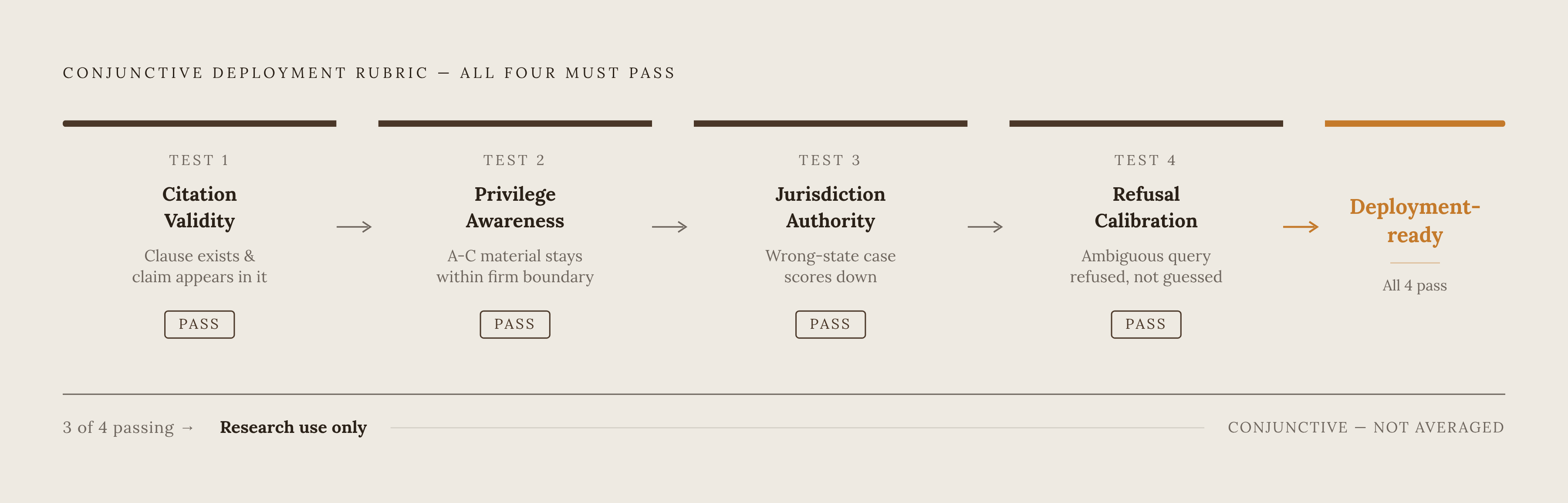
Clause-level citation validity tests the connection between a claim and its precise source. The cited clause must exist in the retrieval context, and a quoted span must match the source text verbatim. Existence alone is not enough to establish support. The claim must also appear in the cited clause, so evaluation examines the relationship between proposition and evidence. Mata v. Avianca, Park v. Kim, and FRCP Rule 11’s reasonable-inquiry standard make that requirement part of the duties that apply to legal submissions.
Privilege awareness tests whether the evaluation process itself respects confidentiality. Attorney-client material must stay within the firm boundary, so rubrics that use confidential data must run within that boundary or leave out confidential fields. The data path is part of deployment readiness. Public LLM APIs can jeopardize privilege when provider terms permit training, retention, or third-party disclosure that defeats a reasonable expectation of confidentiality. ABA Model Rule 1.6 governs client confidentiality, while cross-tenant retrieval represents a serious configuration failure rather than a weakness that can be averaged into a model score.
Jurisdiction-correct authority tests whether a source governs the question the system is answering. A Delaware case applied to a California question must score down when it is presented as governing authority. Evaluation must distinguish finding an authority from selecting the authority appropriate to the jurisdiction. Otherwise, a system can pass a citation-existence test and still fail to do the legal work it was given.
Refusal calibration tests whether the system recognizes the limits of its authority and playbook. On ambiguous or out-of-playbook questions, it should refuse rather than select the nearest plausible legal answer. Confident completion is not always successful completion. Refusal behavior must hold across clause types and jurisdictions in production as well as on prepared test prompts. Together, these four tests form a conjunctive rubric, so passing three establishes suitability for research only.
What task-based evaluation looks like in practice: the CoCoBench model
Thomson Reuters introduced CoCoBench, or CoCounsel Bench, around assignments that reconstruct legal practice. In one task, a client receives an antitrust complaint and asks counsel to assess the claims and identify defenses. The agent receives only the complaint as its starting material. It must identify salient facts, research applicable law, evaluate viable defenses, and produce a client-ready memo. A former Kirkland & Ellis antitrust litigation and investigations partner authored the task, bringing the expectations of a supervising attorney to the assignment.
This structure makes the whole work product the object of evaluation. The automated layer scores consistently at scale, identifies regressions, isolates failures, and examines citation support. Reviewers assess correctness, completeness, readability, and overall professional judgment, including whether the output addresses material issues and is organized well enough to use without reconstruction. Neither layer substitutes for the other, because repeatable scoring and professional assessment expose different weaknesses.
For example, two responses may both mention the relevant legal standard. One merely states it, while the other explains its elements, applies them to the facts, considers competing interpretations, and reaches a defensible conclusion. Presence-based scoring can reward both without distinguishing their usefulness. Thomson Reuters reported that CoCounsel Legal completed complex assignments far faster than the estimated attorney completion time, and that attorneys preferred its responses to expert-written reference answers on a substantial share of tasks. These findings show what realistic task evaluation can reveal, rather than establishing suitability for every legal workflow.
The review process also needs an inspectable record. ABA Formal Opinion 512 interprets ABA Model Rule 5.3 as requiring reasonable supervisory efforts to keep AI use compatible with lawyers’ professional obligations, including review of generated work product. FRCP Rules 11 and 26(g) also require reasonable inquiry. To support that supervision, an evaluation framework must produce reviewer-friendly traces that a partner can inspect and audit. An aggregate score does not supply the basis for reviewing a particular legal conclusion.
Counsel must identify claims, research governing law, assess defenses, and synthesize a memo a client can use.
How benchmark methodology itself distorts legal AI evaluation results
Two snapshots of the same national case-law registry, built and then re-derived a short time later, produced sharply different measured hallucination rates on identical text. The rates moved by an order of magnitude, and the systems’ rank order did not hold. The output had not changed between those measurements. The result therefore described performance against a particular state of the citation graph.
Two scores may reflect different registry states, citation graphs, or evaluation windows, even when presented as measurements of the same capability. The instrument itself becomes part of the result. This is a structural limitation of applying static benchmarks to a dynamic legal citation graph. Cases can be overruled, statutes amended, and jurisdictional standards changed, causing a fixed evaluation to drift from the legal landscape it represents.
Stanford Law’s “The Law of Evaluation” argues for legally grounded, ongoing assessment. A high score cannot show that the same answer is still legally sound after the governing authority changes. The lesson for vendor selection and production monitoring is to use benchmark performance as evidence alongside live, jurisdiction-specific tasks reviewed by practitioners.
The EU AI Act compliance layer that now applies to legal AI in production
Those requirements include risk management, high-quality datasets, activity logging, extensive technical documentation, effective human oversight, and strong accuracy and robustness standards. The rules take effect in phases from August 2026 to August 2028. For affected organizations operating in EU jurisdictions, voluntary quality assurance alone is no longer an adequate frame.
Activity logging provides the traceability needed to examine how a system operated, while human oversight aligns with the attorney-review layer of task-based evaluation. Technical documentation makes the basis of assessment inspectable. These requirements overlap with the supervisory purpose of reviewer-friendly records under professional and procedural rules, even though the legal obligations are distinct. A framework needs the required documentation to meet the Act’s requirements, even if its scores help assess how well the system performs.
“A Conceptual Framework for AI Capability Evaluations” notes that the Act incorporates benchmarks in several key provisions and establishes a government-mandated general-purpose AI evaluation regime. Benchmarks therefore retain a role within regulation. Their inclusion does not remove the need to assess legal work in context or preserve evidence of oversight. Instead, the compliance layer gives institutional form to evaluation practices that already need to connect output, authority, review, and accountability.
Deloitte’s survey findings describe a governance gap between expected adoption and organizational readiness. A large majority of organizations expect at least moderate agentic AI use within two years, while only a small share say they have mature agentic AI governance. Deployment expectations are running ahead of governance maturity. For legal enterprises subject to the Act, the phased timeline narrows the period available to close that gap. Evaluation design must therefore account for documentation and oversight as part of the operating framework from the outset.
Why legal AI evaluation must be treated as an ongoing operational function, not a pre-deployment gate
Pre-deployment testing establishes performance under the conditions of a particular assessment. It cannot show that authority, jurisdictional standards, and model behavior will stay suitable for as long as the system is in production. A passing result has a time-bound basis. If the legal landscape changes, a previously acceptable response may apply superseded law or rely on an overruled case. Ongoing evaluation must therefore revisit the same workflow-specific constraints that supported the initial deployment decision.
Production also exposes a system to changing assignments. New case types, jurisdictions, and document structures can reveal failures that the original task set did not contain. Monitoring serves a different purpose from initial qualification. It detects degradation, identifies newly relevant failure modes, and preserves the audit trail needed for bar inquiries and court challenges. The supervision and reasonable-inquiry obligations associated with Rule 5.3 and Rules 11 and 26(g) make attorney review an ongoing operating responsibility.
For organizations deploying agents across complete workflows, the architectural implication is direct. Document review, case briefing, and contract extraction require evaluation infrastructure that runs with production. Review must remain part of the operational system. The organizations best positioned to meet that standard enter deployment with frameworks designed around their actual legal assignments, instead of retrofitting a generic benchmark after failures emerge. Production readiness depends on maintaining evidence that the system can perform the work under the legal and professional constraints that apply when its output is used.
Notes
- A Conceptual Framework for AI Capability Evaluations
Provided context on how the EU AI Act incorporates benchmarks into its regulatory framework and establishes a government-mandated AI evaluation regime.
- When Legal AI Is Evaluated Like Legal Work, the Results Change - Thomson Reuters Innovation Blog
Provided details on CoCoBench's task-based evaluation methodology and CoCounsel Legal's performance compared to attorney benchmarks.
- 1 The Law of Evaluation: Beyond Benchmarks for AI Governance
Supplied the argument for legally grounded, ongoing assessment of AI systems rather than reliance on static benchmarks.
- AI Agents Under EU Law
Informed the section on EU AI Act compliance requirements including risk management, logging, human oversight, and technical documentation for legal AI.