AI Agent Automation of Legal Case Briefing
Structured agent pipelines reduce hallucination and enable auditable legal research.

- Written by
- Marcus Johanssen
- Published
- October 15, 2026
- Reading time
- 9 min read
What this covers
Legal case briefing is not a single act of legal judgment but a sequence of discrete, repeatable steps: ingest documents, extract facts, research authority, cross-reference jurisdiction, and synthesize findings into a structured output. That sequence is the same on every matter, which makes it precisely the kind of workflow that agent automation handles well. The point is not that case briefing is simple. The point is that its complexity decomposes into stages that can each be specified, executed, and audited.
The work that legal professionals are already automating most frequently bears this out. Briefing sits adjacent to them. The briefing workflow begins where intake and file organization end, and it has the same structured, repeatable character.
The distinction that matters is between retrieving information and executing a workflow. Earlier legal technology answered questions on demand and stopped when the response was delivered. Agents are different: they reason, plan, and act across sequential steps without being re-prompted. Understanding the workflow structure is the key to understanding why agents work here at all.
How a multi-agent architecture mirrors the actual stages of case briefing
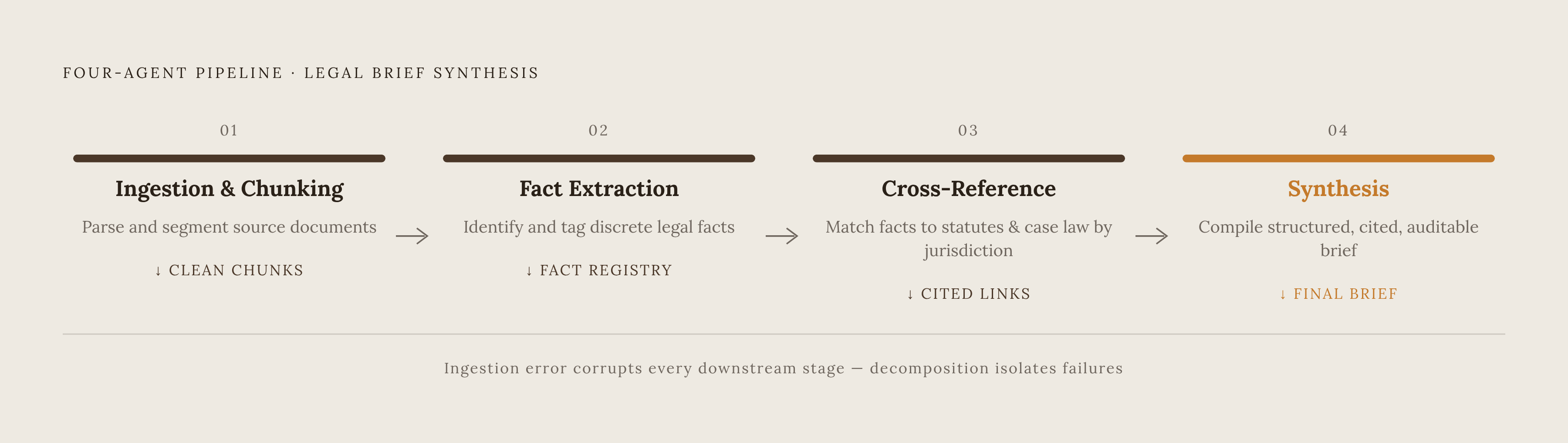
The core architectural principle is decomposition. This is not an arbitrary design choice. It is what keeps error from propagating across the pipeline. When an extraction agent scopes itself to identifying case facts and leaves legal research to a separate agent, a mistake in one stage does not silently corrupt the next.
A representative pipeline runs four agents in sequence. The cross-reference agent validates those facts and legal claims against jurisdiction-specific statutes and case law. Each stage has a narrow mandate, and each stage feeds the next with a defined output.
This structure mirrors how experienced legal professionals actually work. Yu, Huang, and Shao, writing in a SAGE Journals paper in 2026, demonstrated that an iterative, role-separated approach produces measurably better case-fact management than single-model approaches. The multi-agent architecture reproduces that professional cadence rather than replacing it with a black box.
The practical consequence is auditability. A pipeline decomposed into role-specific agents is one where each step can be inspected independently, the way a senior partner reviews associate work. An architecture that makes each stage inspectable is an architecture that can be deployed in a regulated environment.
What agents handle at the document ingestion and fact extraction stage
Ingestion is where agent design choices carry the largest downstream consequence, because poor structuring at this stage compounds errors through every step that follows. The agent must parse unstructured documents, including PDFs, scanned filings, and medical records in personal injury matters, then chunk them into semantically coherent units and build a structured representation the downstream agents can reason over. If the chunks are wrong, the extraction is wrong, and nothing after it can be right.
Production platforms demonstrate what this looks like at scale. Personal injury work illustrates the complexity: Supio builds searchable medical chronologies and case timelines from unstructured medical and incident records. The agent does it as an upstream stage in a larger workflow.
Extraction builds on ingestion. Extraction quality depends on how specifically that playbook is defined. The more precisely a firm encodes its own playbook, the more accurately the agent extracts what that firm needs.
How agents handle legal research and jurisdiction-aware cross-referencing
Legal research and cross-referencing is the stage where standalone large language models fail most visibly and where agents succeed by being architecturally different. A standalone model hallucinates citations and produces outdated case law because it reasons from training data frozen at some past moment. The CMU/Stanford survey frames the distinction explicitly: agents address hallucination and outdated information through tool use and memory, not by being better language models but by being differently constructed systems.
The Thomson Reuters CoCounsel Legal product illustrates the approach in production. Launched with Deep Research capabilities in August 2025, it connects legal research databases to AI agents and enables jurisdiction-aware case-law comparisons through its Westlaw integration. Jurisdiction-awareness means the system checks whether cited cases bind the court in question, a step that a model reasoning from its weights cannot reliably perform.
Semantic search deepens the advantage. Agents identify a "duty to defend" case even when the query mentions only "insurance obligations," because semantic search understands conceptual equivalence rather than matching keywords. The difference is not a marginal improvement in retrieval quality. It is the difference between finding the controlling authority and missing it entirely.
What the synthesized brief output looks like and what makes it production-grade
A production-grade brief is not a summary. It is a structured, auditable document with cited findings, flagged risks, and traceable reasoning that a supervising attorney can verify efficiently. The checklist format is designed for verification speed, because the attorney reviewing the output is the person whose time determines whether the system actually saves anything.
Spellbook's Playbooks feature demonstrates the form. It applies firm negotiation standards against any contract and produces a structured checklist of what passed, what failed, and what needs attention, with accepted redline suggestions tracked under the lawyer's name. Tracked changes under attorney names, audit logs of agent decisions, and citation links allow a reviewer to verify each claim independently against its source.
Three conditions separate a production-grade output from a polished demo: reproducibility, explainability, and auditability. The output format is where those conditions become concrete. An audit log that records which agent made which decision, and a citation trail that allows each claim to be checked, turn the brief from an assertion into evidence.
Why hallucination in legal AI is a professional liability problem, not just a product quality issue
Hallucination in legal AI is not a temporary product limitation to be tolerated until the next model release. It is a professional responsibility problem that determines whether agent deployment is ethically permissible at all without structural safeguards. The cases establish this in the starkest possible terms. Avianca, AI fabricated whole cases, a second lawyer failed to verify citations, and the court sanctioned both individual attorneys and their firm, not merely to remedy the immediate misconduct but to send a clear warning that unverified AI output cannot be passed off as legal research.
The consequences have not been limited to private practitioners. In Fivehouse v. U.S. Department of Defense, an Assistant U.S. Attorney submitted a brief containing fabricated quotations and misstatements of case holdings drawn from multiple Fourth Circuit opinions and the Code of Federal Regulations. The court found his conduct knowing and intentional and imposed a public reprimand, but limited that sanction in recognition of the severe professional consequences the attorney had already suffered, including the loss of his position.
The vendor claim that retrieval-augmented generation solves hallucination deserves scrutiny. A Stanford/Journal of Empirical Legal Studies study in 2025 found that leading legal AI tools hallucinate on a meaningful share of queries, and in the absence of transparent third-party benchmarking, lawyers are being asked to trust marketing claims that have not been independently verified. The Thomson Reuters Institute has acknowledged the deeper issue: even sophisticated multi-agent systems that appear to check their own work are still making statistical predictions, and no number of verification loops can guarantee accuracy. AI presents errors with the same confident tone as correct answers.
The implication is that human review at the output stage is not optional overhead. It is the professional responsibility obligation that makes agent deployment legally permissible. The agent's role is to reduce the time required for expert review, not to replace it.
The governance and compliance infrastructure that separates pilots from production deployments
The reason most legal AI agent pilots never reach production is not that the agents cannot do the work. It is that the deployment infrastructure required by enterprise security, compliance, and regulatory teams is absent. The blocker pattern is straightforward: isolation, governance, compliance controls, and data residency requirements have to be in place before any agent touches production systems, and most pilots lack them.
Deployments that reach production consistently share three conditions identified across regulated financial institution deployments. Governance controls require role-based access control, audit trails, approval workflows, and version control built in from day one. Deployments that stalled were missing at least one of these conditions, and the gap most often missed was governance, not capability.
The EU AI Act makes these requirements specific and dated. Enforcement for high-risk AI systems begins in December 2027, and broader enforcement powers are active from August 2026. The Act requires lineage-backed auditability and human oversight for high-risk systems. The compliance architecture analysis by Nannini et al., published in April 2026, establishes that high-risk agentic systems with untraceable behavioral drift cannot currently satisfy the Act's essential requirements. The foundational compliance task is an exhaustive inventory of the agent's external actions, data flows, connected systems, and affected persons.
Nannini et al. identify agent-specific compliance challenges beyond standard AI regulation: privilege minimization outside the generative model, oversight evasion risk from reinforcement learning, and runtime behavioral drift, the boundary between anticipated adaptive behavior and substantial modification under Article 3(23). Legal AI sits in a regulatory environment that still lacks complete guidance on AI agent decision-making in high-stakes contexts. Governance is infrastructure, not paperwork. It is the engineering condition for production.
How production platforms implement the full pipeline today
Production legal AI agent platforms in 2026 are differentiated not by whether they automate the case briefing pipeline but by which segment of it they own and how deeply they integrate into a firm's existing systems. No single platform covers every practice area or workflow segment. Contract-heavy teams, litigation shops, and in-house departments each need different capabilities, and the market has organized itself around those differences.
Thomson Reuters CoCounsel Legal, launched with Deep Research capabilities in August 2025, connects legal research databases to AI agents and enables jurisdiction-aware case-law comparisons through its Westlaw integration. LexisNexis Lexis+ with Protégé, rebranded from Lexis+ AI in February 2026, provides case summaries, memos, and automatic real-time citation checks via Shepard's, and includes a no-code builder for creating custom multi-step workflows that codify firm playbooks and institutional standards into repeatable processes. Spellbook operates in Microsoft Word: it generates structured first drafts from firm-specific knowledge, applies negotiation standards through its Playbooks feature, and handles bulk document analysis through Vault.
Legora, acquired Walter AI to expand agentic capabilities, focuses on end-to-end matter management, with Tabular Review producing searchable, cite-backed tables in minutes and Agentic Workflows reducing eDiscovery review from weeks to days across Outlook intake, iManage DMS research, and Word drafting without human handoffs. Darrow takes a different position entirely: a Legal Intelligence platform for case origination, using anomaly detection algorithms to identify potential legal violations from publicly available data, with every AI finding reviewed by human analysts and a predictive underwriting service for portfolio assessment. It serves plaintiff firms building class action and mass tort cases rather than briefing defense matters.
What determines whether a legal AI agent deployment succeeds or stalls before production
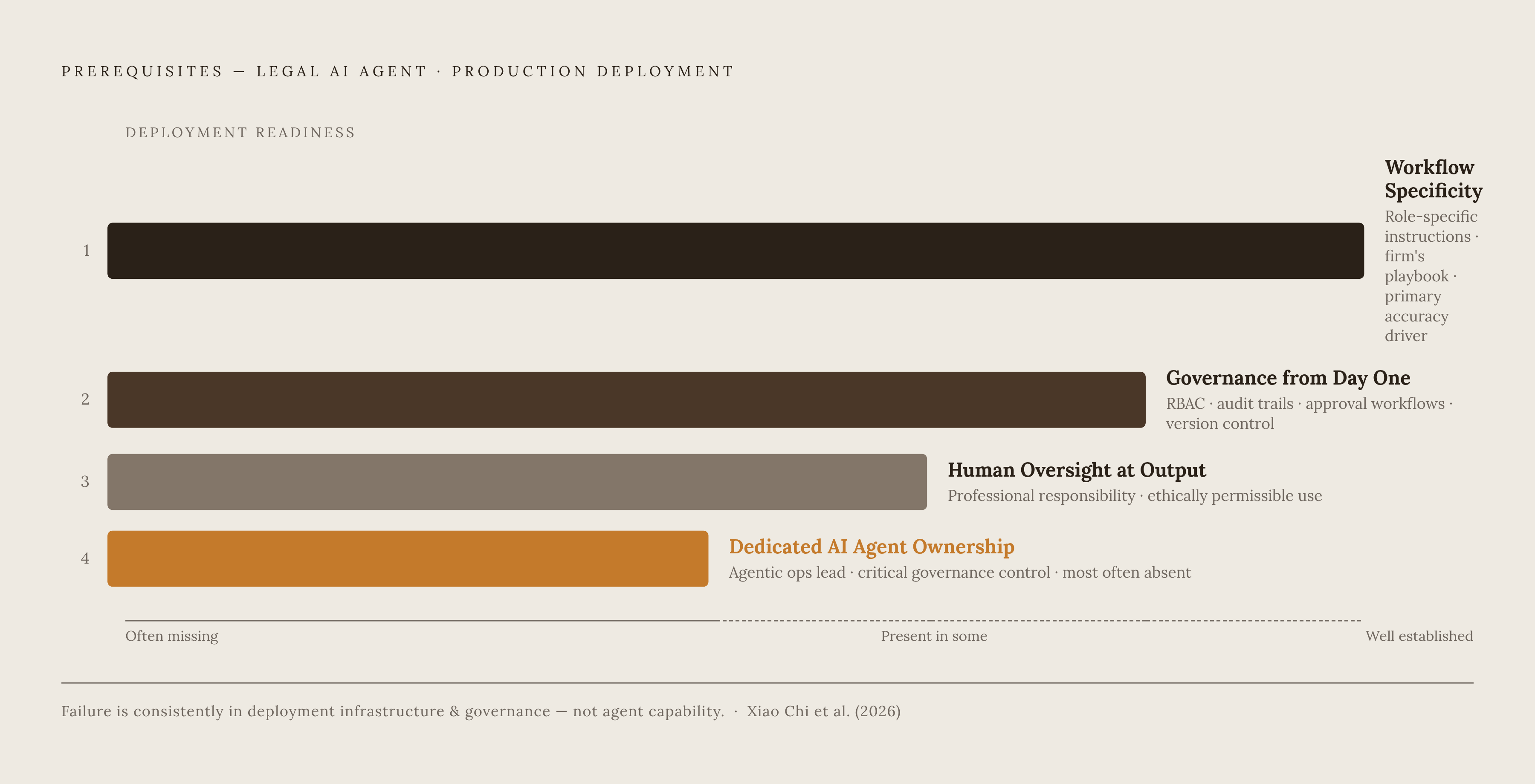
Whether a legal AI agent deployment reaches production depends less on which platform is chosen and more on whether the organization has done the operational groundwork before the agent goes live. The production gap is a documented pattern: most enterprises run AI agent pilots, but a small minority reach production scale, and the failure is consistently in deployment infrastructure and governance, not agent capability. The groundwork has four components. Workflow specificity requires the agent to receive structured, role-specific instructions tied to the firm's actual playbook, not open-ended prompts. Per Xiao Chi et al. in a 2026 Springer paper, this is the primary accuracy driver. Governance must be built in from day one: role-based access control, audit trails, approval workflows, version control, not retrofitted after deployment. Human oversight at the output stage is mandatory, the professional responsibility obligation that makes agent use ethically permissible. And dedicated AI agent ownership, an agentic ops lead, is a critical governance control that separates programs that scale from those that stall.
An AI Operations Audit is the structured mechanism for surfacing which of these conditions are in place and which are gaps before a deployment begins. It is a systematic evaluation of organizational maturity across data, technology, governance, security, people, workflows, and ROI measurement. An audit that surfaces human capital and culture gaps produces higher ROI from subsequent AI projects than one focused on technology alone, because refocusing misallocated resources is often the fastest path to measurable returns. If a legal AI agent deployment cannot show measurable gains in brief output speed, attorney review time, or matter throughput within the first deployment cycle, the deployment design, not the technology, is the problem.