Legal Workflows Worth Automating Before Client-Facing Ones
Internal automation builds the governance and error recovery that client-facing AI depends on.

- Written by
- Renata Voss
- Published
- October 14, 2026
- Reading time
- 10 min read
- Sources cited
- 1 sources ↓
What this covers
Firms that wait to automate client-facing legal work are not falling behind.
Why the Sequence of Legal AI Deployment Is a Risk Architecture Decision
The loudest message in legal tech circles this year is that firms moving slowly on client-facing automation are losing ground to competitors who moved first. The ABA's Task Force on Law and Artificial Intelligence said in its December 2025 final report that AI is "rapidly becoming core infrastructure for law practice, courts, legal education and access-to-justice efforts. That word, infrastructure, is doing real work in that sentence. Infrastructure is built in a specific order, because later layers depend on earlier ones holding weight. No contractor wires a building's client-facing systems before the electrical panel is grounded, and no firm should expose clients to AI-driven decisions before the internal controls that make those decisions safe actually exist. The real question a firm needs to answer is what conditions have to exist before client-facing automation is safe to deploy at all, and those conditions are precisely what internal automation builds.
Where legal AI lives in 2026
Legal professionals are already putting AI to work internally first, without anyone having to argue for that pattern. Thomson Reuters' 2025 Generative AI in Professional Services Report looked at legal professionals using AI tools and found the top use cases are document review, legal research, and document summarization. All three happen behind the scenes, long before anything reaches a client's inbox. The 2026 AI in Professional Services Report shows GenAI adoption climbing year over year across law firms and corporate legal departments, with corporate legal teams posting the sharpest increase, a sign that in-house teams are building out internal infrastructure at a fast clip. What these internal use cases share is a structural trait: they run at high volume, follow repeatable patterns, and any error they produce is recoverable before it leaves the building. Taken together, this distribution is the fingerprint of internal-first sequencing already running at scale, whether or not the firms doing it would describe it in those terms.
Regulated Environments Make Client-Facing Deployment the Most Dangerous Starting Point
Legal operates in a regulatory gray zone when it comes to AI agents making decisions, and sending a client-facing agent into that zone before a firm has hardened its internal governance creates liability exposure that can swallow whatever efficiency gain the automation was supposed to deliver. A March 2026 federal ruling out of Colorado, Morgan v. The EU AI Act is now in force, and while its requirements for high-risk AI systems, including human oversight and audit trail obligations, will not bind most such systems until December 2027 or August 2028, those are exactly the obligations that client-facing legal deployments trigger first. A recent ABA Formal Opinion lays out the duties that remain central when lawyers use generative AI: competence, confidentiality, client communication, supervision, candor toward the tribunal, and reasonable billing. Every one of those duties gets harder to honor when the governance infrastructure needed to support them has not been built yet. Many off-the-shelf workflow tools route intake data through shared API endpoints before that data becomes useful to anyone, so confidential client information crosses a network boundary to a vendor the firm cannot audit, before the firm has even assessed the matter. Firms getting this right run AI on infrastructure they control. In a client-facing workflow, the first casualty is the firm's professional obligation to the client itself.
The internal workflows that deliver the highest operational return before any client sees an output
The workflows worth automating first share three traits: high volume, structural repetition, and an error cost the firm can absorb without anything reaching a client. Several of them deliver returns that rival anything a client-facing tool promises.
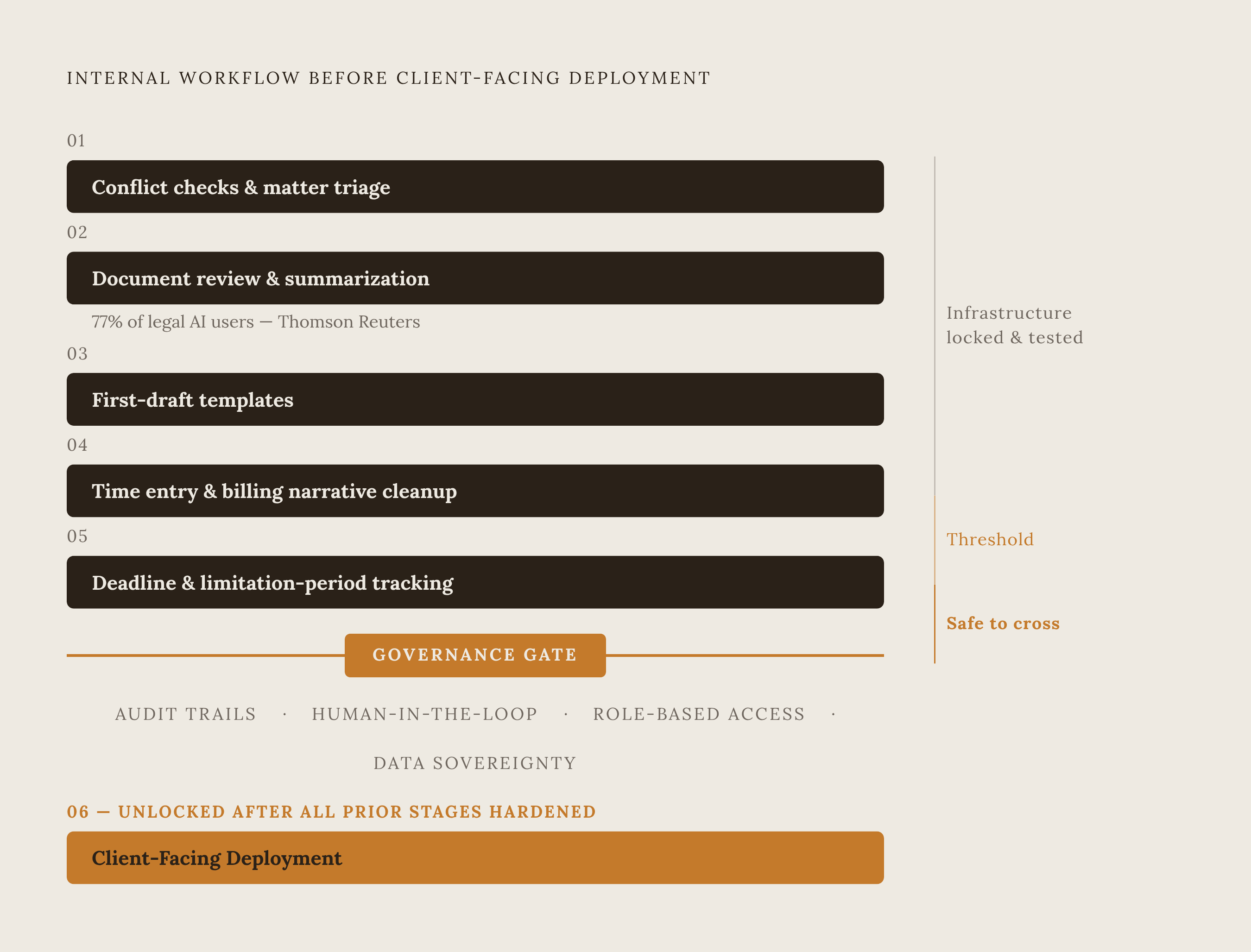
Conflict checks and matter triage sit at the front of the list. Running a conflict check late in intake wastes billable work that has already been performed. Automating the check at the point of intake catches the problem while it is still recoverable, before it becomes irreversible. Matter triage routes incoming work to the right practice group or attorney, it happens constantly, and it follows predictable patterns, so it makes an ideal first target for automation.
Document review and summarization follow close behind, and the data backs this up directly. Document review is the most widely adopted AI use case among legal professionals: Thomson Reuters found that 77% of legal professionals using AI tools apply them to document review. Structured templates with AI filling in the variable fields consistently outperform open-ended AI drafting: less hallucination risk, more predictable output, and attorneys reviewing deviations from a known template rather than evaluating an unfamiliar document from scratch.
First-draft engagement letters and NDAs fit the same profile: high volume, low variability, which makes them a natural entry point for drafting automation. Consistency reduces the review burden on senior attorneys and makes quality control something the firm can actually manage.
Time entry generation and billing narrative cleanup belong on the list for a different reason. These are back-office workflows where any error cost is financial and internal, never professional or external, and automating them has a direct line to revenue recovery: firms capture billable time that would otherwise go unrecorded, with no client-facing exposure created in the process.
Deadline and limitation-period tracking rounds out the list. It happens less frequently than the other workflows, but the severity of a missed deadline carries financial and legal consequences that dwarf the cost of automating the tracking itself. Getting this right internally, before building out client-facing pipelines, protects the firm's professional standing directly.
None of these workflows are simply operationally convenient. Each one is a training ground. Every conflict check automated, every document reviewed, every deadline tracked without incident builds the muscle memory and the technical scaffolding that client-facing automation will eventually need to stand on.
The Governance Infrastructure Client-Facing Deployment Requires
The governance infrastructure that client-facing legal AI needs, audit trails, human-in-the-loop queues, role-based access control, data sovereignty controls, approval workflows, does not arrive pre-built. A firm builds and stress-tests it through the internal automation work it does first. An explicit human approval step turns out to be the single most effective compliance measure available: not a vague assurance that "the lawyer reviews it," but an actual queue where nothing moves forward until someone clicks approve. Most compliance concerns dissolve once that queue exists and is enforced.
Internal workflows give a firm something client-facing deployment cannot: a proof-of-concept environment where failure is containable. A document review error caught internally becomes a learning event. The same error surfacing in front of a client becomes a professional liability event, and the two outcomes are not comparable in severity.
Across regulated deployments generally, the ones that reach production share three conditions. The first is deterministic execution: outputs that are reproducible and auditable, not a black box that generates something different each time it runs. The second is data sovereignty: sensitive information stays within environments the firm has actually approved, not environments a vendor controls. The third is governance controls built in from day one, meaning role-based access control, audit trails, approval workflows, and version control, not retrofitted after a problem surfaces. Deployments that failed or stalled were typically missing at least one of these three conditions, and that pattern holds regardless of industry.
A common failure mode illustrates what happens when a firm skips this work. Documents get generated by an automated system, then someone sends them manually. Follow-ups happen over email, outside any tracked process. No one has visibility into who signed and who did not. This is what an unfinished automation pipeline looks like, and it teaches a firm nothing about whether it is ready for client-facing deployment. Firms that automate their internal workflows coherently, intake data flowing directly into matter management, billing triggers firing automatically from document generation, conflict checks running at the point of first contact, are building the integration architecture that client-facing agents will eventually depend on. Firms automating piecemeal are accumulating integration debt instead, and that debt comes due exactly when the firm tries to move to the next phase.
Why most enterprise AI initiatives stall
The gap between running an AI pilot and reaching production at scale is the main obstacle enterprise AI deployment faces right now, and legal firms that skip internal hardening are rushing straight into the most dangerous phase of that curve. A client-facing legal AI deployment that launches without internal governance infrastructure already in place creates privilege and regulatory exposure that an internal deployment does not carry, and the scale of the broader production failure problem across enterprise AI makes that exposure concrete.
The practical consequence for a law firm is specific: deploying client-facing intake automation before resolving data sovereignty, audit trails, and ownership of AI outputs does not accelerate the firm's AI program. It front-loads the failure risk onto the single most professionally sensitive part of the firm's operations.
Healthcare offers a useful parallel, because the field has converged on the same internal-first logic for structurally similar reasons. Agents handle the first pass on claims, coding, and prior authorization internally, while humans review the work before submission, sign off on denials, and handle appeals and exceptions by hand. The domain depth required, ICD-10 coding, HIPAA handling, payer-specific rules, cannot be satisfied by a general-purpose model without real fine-tuning or augmentation for that specific domain. Legal faces the same constraint: jurisdiction-specific compliance cannot be satisfied by a general model either. Legal, like healthcare, sits in a context where an output's adequacy often cannot be tested until it has already reached a consequential moment, a filed brief, a signed agreement, a missed deadline.
Assessing which internal workflows are ready to automate, and in what order
There is no universal ranking of which internal workflow to automate first.
A readiness assessment scores a firm across five dimensions: data, infrastructure, talent, process, and strategy. The output of that assessment is a sequenced deployment plan, not a blanket yes-or-no verdict on whether the firm is ready for AI in general. Granularity matters here down to the level of the individual task. A single legal activity can bundle work of wildly different difficulty inside it, so the right unit of analysis is the task itself, not the workflow as a whole. Automating the easy tasks within a workflow while leaving the harder ones to a human reviewer is a legitimate and safe first move, not a half-measure.
Process discipline deserves particular attention in legal specifically. Firms that see early wins from automation are, almost without exception, firms that already had clean processes before they introduced AI. Firms that struggle are automating chaos and calling it transformation. The AI itself does not fix a broken process; it amplifies whatever discipline already exists in the firm's workflows.
Before deploying any automation, a firm needs to capture baseline metrics: current time spent per task in the target categories, current outside counsel spend on those same categories, and the volume of intake in those areas over the prior three to six months. Without that baseline, measuring ROI afterward is impossible, and governance has no reference point to check itself against. Useful ongoing metrics include contract cycle time from request to signature, the number of contracts reviewed per lawyer per week, and the share of agreements flagged for non-standard risk language, all measurable without any client ever touching the automated system.
Internal Automation and the ROI Evidence for Client-Facing Deployment
Internal automation does more than build governance infrastructure. It generates the measurable ROI data that makes the case for client-facing deployment later, turning careful sequencing into a compounding advantage. Thomson Reuters' Future of Professionals Report found that 53% of respondents say their organizations are already seeing a return on investment from their AI spending. That figure reflects deployments that had the internal governance in place to measure outcomes in the first place, not pilots running without a baseline to compare against.
The challenge of convincing a CFO is distinct from the challenge of measuring results, and firms often conflate the two. Platform choice ends up mattering less than most firms assume. The firms reporting tangible value are the ones that redesigned their workflows around AI rather than layering AI on top of a process that never changed, and internal workflows are the lower-risk setting in which a firm learns that redesign discipline before it matters more.
The strongest objection to all of this is that client-facing intake automation represents the highest-revenue opportunity a firm has, and that internal-first sequencing means surrendering that opportunity to competitors willing to move faster. The response is not that intake automation is a mistake. The response is that deploying intake automation without the governance infrastructure this sequencing builds is the fastest way to create a liability event that shuts the entire program down. A firm that stalls its AI program through a premature client-facing launch loses more ground than a firm that built internal infrastructure first and only then deployed client-facing tools on a foundation that could hold the weight. The firms that end up scaling their AI programs successfully are the ones that can walk into a board meeting or a partners' meeting and show a documented progression from internal wins to client-facing deployment, not the ones defending a client-facing rollout gone wrong.
Once internal infrastructure is hardened and the ROI is documented, client-facing deployment becomes safer and the firm has little reason not to pursue it. At that point it is faster and safer than it would have been without the sequencing, because the firm has already proven, on its own internal workflows, what its governance can and cannot handle.
Methodology & sources
- What legal professionals say about the role of AI and law in 2026
Provided adoption statistics, report findings on top AI use cases, and framing language quoted throughout the article, including the ABA infrastructure characterization and the 77% document review figure.