Essay Legal Workflow Automation
AI Agents vs Rule-Based Automation in Legal Operations
Pick the right tool for each legal task: rules handle structured work, agents handle judgment calls.
Legal operations should assign AI agents and rule-based automation by task structure. Rules work well when inputs are structured and exceptions are rare, while bounded agents suit unstructured inputs and frequent exceptions. The best deployments use both, with clear rules for what agents can do and separate measures of the net value each layer brings.
Why the rule-based versus AI agent question is structural, not philosophical
Rule-based automation follows predefined trigger, condition, and action logic, producing the same output from the same input. An AI agent receives a goal and decides at runtime which steps to take. The distinction is between work whose path can be specified in advance and work whose path depends on what the system encounters.
In legal operations, approvals, routing, and data validation generally fit the first model. Contract review, legal research, and compliance monitoring often fit the second because their inputs and exceptions resist exhaustive specification. Neither architecture is a universal substitute for the other. Assigning an agent to predictable work adds computational cost and unnecessary unpredictability, while assigning a rules engine to work that requires judgment creates brittle handling of exceptions.
What rule-based automation handles well in legal workflows, and why that list is finite
Rules work well for contract routing by counterparty type or dollar threshold because defined fields and conditions guide the decision. NDA approvals also fit when fixed playbook criteria determine the result. The boundaries are known before processing begins. The same is true of checking invoices against outside counsel guidelines, using deadline and matter management triggers, and filling templates with structured CRM or ERP data. Each can translate an established policy or known data relationship into a repeatable action.
That repeatability has particular value in legal work. A deterministic workflow gives a decision trace through branches set in advance, so the audit trail is built in and needs no extra work to interpret how the decision was made. For regulators, outside counsel guideline enforcement, or litigation hold purposes, that record can be a compliance prerequisite. The record may itself be a required deliverable. Rule-based systems also have lower computational costs and take less time to certify under existing legal IT governance frameworks, which makes them a better fit where flexibility adds little value.
As complexity grows, the rule set grows exponentially, yet an unanticipated input still falls outside what the workflow author designed. Faced with that input, a rules engine may fail silently or follow a default branch, potentially leaving an obligation missed or a risk unreviewed. These failures define the boundary of rules’ useful coverage and explain why legal work cannot be automated through increasingly elaborate branching alone.
Where AI agents take over — the tasks defined by unstructured input and frequent exceptions
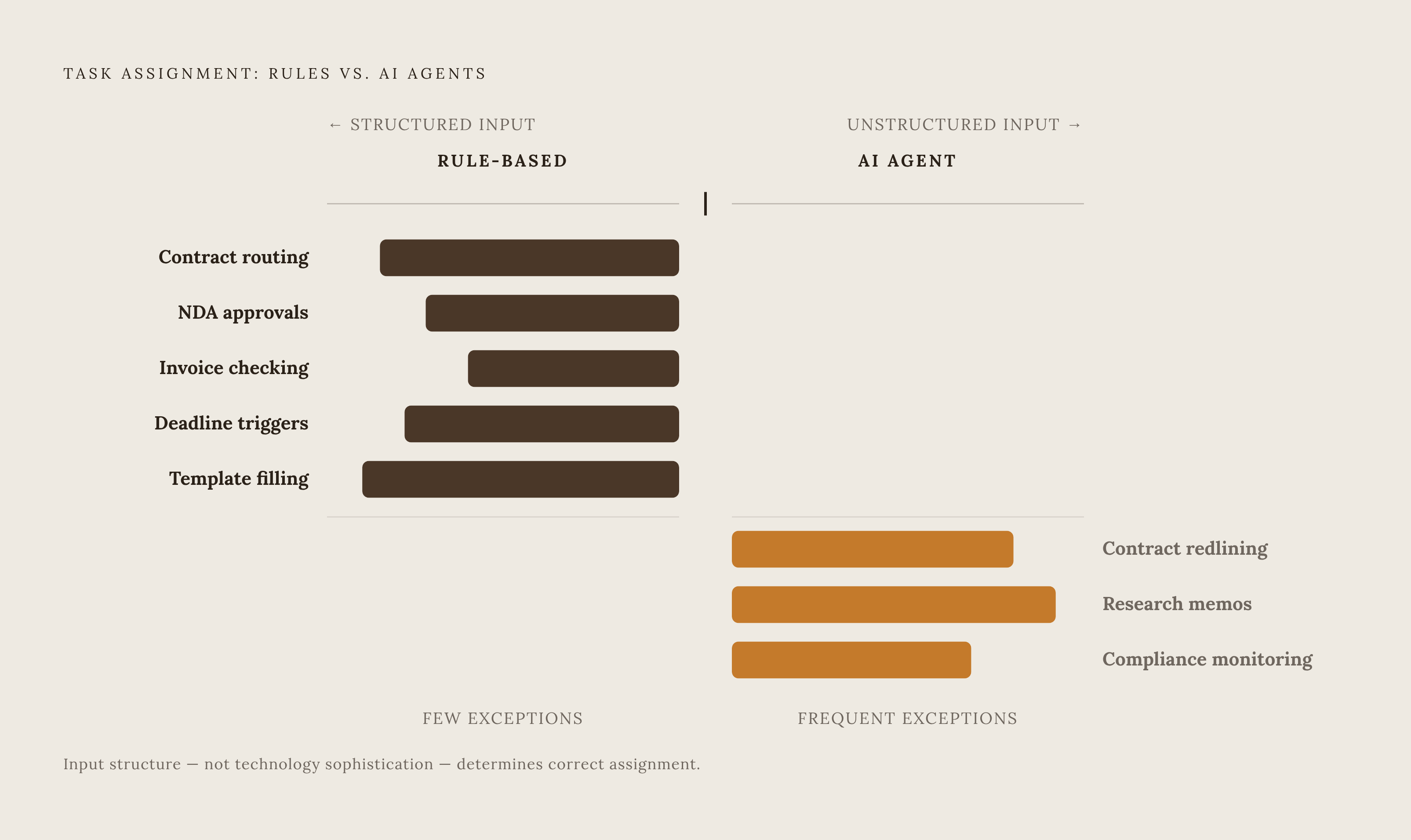
Free text, scanned documents, and long agreements whose clause patterns change call for more than structured processing. The system must interpret what has arrived before deciding how to proceed. This is where agent architecture earns its place. In contract review and redlining, an agent can check terms against a playbook and flag deviations, with routine agreements moving from hours of manual work to minutes. The relevant advantage is its ability to process variation within that defined review task.
Research memo drafting requires navigating unstructured case law and statutory text to produce citation-backed summaries that previously required associate hours. Compliance monitoring tracks regulatory change against a matter portfolio, where inputs are open-ended and exceptions are frequent.
The Carnegie Mellon–led survey LLM Agents in Law: Taxonomy, Applications, and Challenges describes the transition from standalone language models to agents with planning, memory, and tool use. Those capabilities address hallucination, outdated information, and verifiability problems that limit standalone models in high-stakes legal work. They do not remove the need for oversight. The 2026 deployment pattern has moved beyond copilots toward agents that drive a defined stretch of work, such as extracting terms, checking a playbook, and flagging deviations, rather than merely suggesting edits while a lawyer directs every step.
Platforms active in legal operations as of 2026 include Ironclad, Luminance, Litera (Kira), Robin AI, SpotDraft, Relativity, Lexis+ with Protégé (formerly Lexis+ AI), and Spellbook. Each handles a defined part of a workflow, with limits on the legal judgment it can use. Their relevance to the comparison is therefore architectural. Production-ready agent work has a specified remit, even when the reasoning needed inside that remit cannot be reduced to fixed rules.
The strongest objection to AI agents in legal ops — auditability is not optional
An agent’s ability to complete a task does not establish that its decision is defensible. Legal decisions must stand up to review by auditors, regulators, and opposing counsel, yet agents do not produce a full decision trace by default. A deterministic workflow traces written branches, while an agent needs logging built into its architecture to make the same kind of record. A useful result without a reconstructible account of the actions behind it leaves a governance requirement unmet.
The Parallax paper argues that prompt-level guardrails are architecturally insufficient for agents with execution capability. Its central concern is that the reasoning system and the threat share the same computational substrate, leaving prompt-only safety unreliable at enterprise scale. This objection becomes acute when an agent can act, rather than merely provide text for review, because governance must cover what it is permitted to execute.
Legal and healthcare both have high stakes, strict auditability requirements, and a risk of liability when governance fails. Organizations can have agents in production without formal governance frameworks, so deployment status is not evidence that these obligations have been met. Capability cannot stand in for control design. Agents should not be dismissed, nor should a weaker record be accepted because their outputs are useful. Logging, consequential human checkpoints, and testable task boundaries have to be designed before deployment.
In legal operations, approvals, routing, and data validation generally fit the first model.
How to scope legal agent deployments so the audit trail holds
For legal ops teams translating that objection into architecture, the practical pattern is a deliberate hybrid. Rule-based guardrails set the boundaries, and an agent handles open-ended reasoning within them. Scope must be concrete enough to test. An agent that reviews a contract against a playbook and flags deviations has a bounded assignment, while an agent asked to handle the contract lifecycle does not. Broad assignments expose the deployment to compounding quality variance and edge cases whose acceptable outcomes are difficult to specify.
Within that boundary, cognitive-executive separation provides a distinct control over action. The reasoning system proposes a step, and a separate validation layer approves it before execution. Parallax treats this as an architectural boundary. It is not simply another instruction telling the agent to check its own work, because the purpose is to separate reasoning from authority to act.
An agent can keep flagging routine clauses, but a person should approve any deviation that triggers a contract hold or an outside counsel escalation. Logging needs an equally explicit scope. Every agent action should be recorded at the step level, rather than only as a final outcome, so the record can be reconstructed for privilege review or regulatory inquiry. Where execution is reversible, capturing pre-destructive state allows failed validation to be rolled back without permanent record alteration.
This design preserves distinct responsibilities across the workflow. Structured, high-volume, low-exception routing, approvals, and deadline triggers remain with rules, while unstructured review, research, and compliance work goes to bounded agents under explicit governance. The separation places determinism at the points where legal governance requires fixed boundaries and permits interpretation where the input demands it. An output that the team can measure for each assignment also lets it test quality before giving the system more work.
Why most legal AI deployments stall before reaching production — and what separates the ones that don't
Tasks need to go to the right system, but work will move beyond a pilot only if the organization is ready. The recurring blockers are infrastructure gaps, governance and security concerns, and an inability to measure ROI. A capable agent cannot supply those foundations. Rule-based automation faces the same problem when an organization lacks data it can use, written processes, or someone who owns the workflow. Choosing the right architecture does not compensate for deploying it into an operation that cannot sustain it.
For a legal ops team assessing readiness, the first question is whether contracts, matters, and compliance records are in a format agents can consume. Governance assessment then asks whether logging and approval architecture exist, rather than whether general AI principles have been written. A mature process has a target workflow documented well enough to bound the assignment. Ownership must also be explicit before deployment. Someone must be accountable when an agent output is wrong, because technical scope alone does not establish organizational responsibility.
Legal’s slow governance approval cycles can make this preparation appear to delay value, but its high auditability requirements make the work a condition of production readiness. Grant Thornton’s 2026 AI Impact Survey found that fully integrated organizations were nearly four times more likely to report revenue growth than those still in the pilot phase. That association, without establishing causation on its own, links integration and accountable operation more closely to realizing value than a successful demonstration alone. Governance work belongs in the deployment foundation.
Measuring whether the assignment is working — ROI signals that distinguish rule-based and agent performance
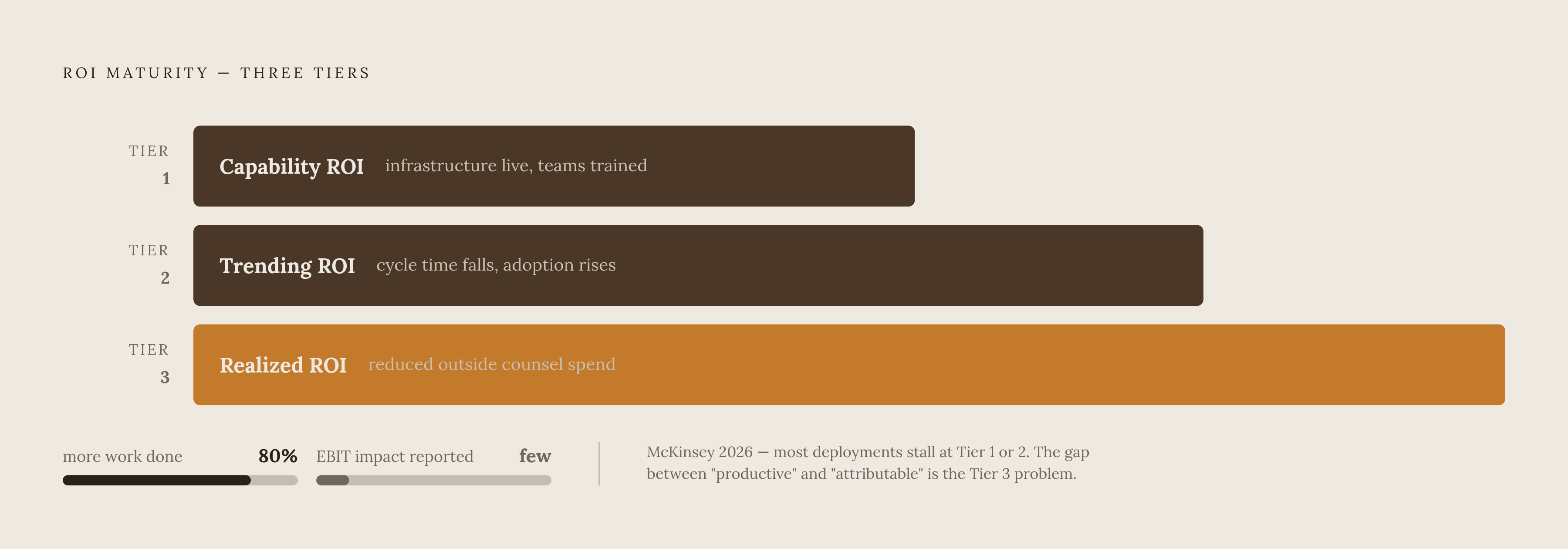
Measurement must distinguish a working deployment from a valuable one. McKinsey’s 2026 findings show that 80% of respondents say AI helped them get more work done, while far fewer say it had an impact on earnings. The gap remained wide between 2025 and 2026, with the share reporting EBIT impact barely shifting year over year. More activity is not a financial outcome. For legal ops, the measurement problem is to connect each system’s output to an attributable improvement rather than treat usage or time saved as sufficient proof.
A three-tier framework separates those claims by maturity. Capability ROI means the infrastructure is live, teams are trained, and the agent or rules engine processes real work. Trending ROI appears when contract review cycle time falls, the rules layer has fewer exceptions to handle, or more people use the system. These signals show whether the assignment is moving in the right direction, but they still need a connection to a defensible financial result.
Realized ROI requires an attributable change in cost, revenue, or liability. Examples include reduced outside counsel spend or associate review hours, increased revenue through faster deal close, or a compliance breach caught before it materializes. Net return is the defensible number here. For bounded agent tasks such as playbook-based redlining, regulatory filing preparation, and patent prior-art search, meaningful reductions in review cycle time are credible directional signals. Gross benefits that omit implementation, change management, and re-tooling costs substantially overstate the return available to defend to general counsel and the CFO.
The hybrid architecture makes that attribution more precise because routing and approvals produce different outputs from review and research. A team can measure the rules layer’s exception volume separately from the agent layer’s review cycle time, then locate the underperforming assignment when results disappoint. Aggregate productivity figures obscure that distinction too easily. The practical test is whether each layer delivers an auditable result after its costs are included. If the team cannot measure the assignment layer by layer, it cannot manage it.