Essay Legal AI Platforms
AI Liability and Malpractice Risk in Law Firm AI Deployments
Attorneys bear the liability for AI errors, so verification is essential.
Law firm AI deployments leave professional liability with the attorney. Sanctions, malpractice claims, coverage disputes, and bar discipline make verification and governance the central conditions of responsible adoption. Firms can gain from AI without surrendering professional accountability, but only when their controls are documented, their outputs are independently reviewed, and their insurance position is understood before use expands.
Why AI liability in law falls entirely on the attorney, not the vendor
No malpractice framework transfers an attorney’s professional responsibility to an AI vendor. Mata v. Avianca exposed that asymmetry when attorneys were fined for submitting briefs with fabricated AI-generated citations, while the vendor faced nothing. The tool produced the text. The attorneys submitted it. For malpractice purposes, the software does not displace the professional who owes duties to the client and the court.
ABA Formal Opinion 512, issued July 29, 2024, applies those duties to generative AI through Model Rules 1.1, 1.4, 1.5, 1.6, 3.1, 3.3, 5.1, 5.3, and 8.4(c). Its reach includes competence, communication, reasonable fees, confidentiality, meritorious claims, candor, and supervision. These are existing obligations applied to a new tool.
Rule 1.1 makes technological competence a standing professional obligation, so ignorance of how AI works is not a defense. Rule 5.3 supplies the supervision requirement. AI output must receive the review expected of work produced by a nonlawyer before it reaches a client or tribunal. That responsibility extends beyond deciding whether a passage sounds plausible to determining whether its authorities, facts, and conclusions can be supported.
A vendor may supply the system, but the attorney remains responsible for the words that leave the firm. Consequently, deployment depends on the firm having a reliable process for preventing an unverified output from becoming professional work product.
How fast the sanctions record is growing and what the cases show
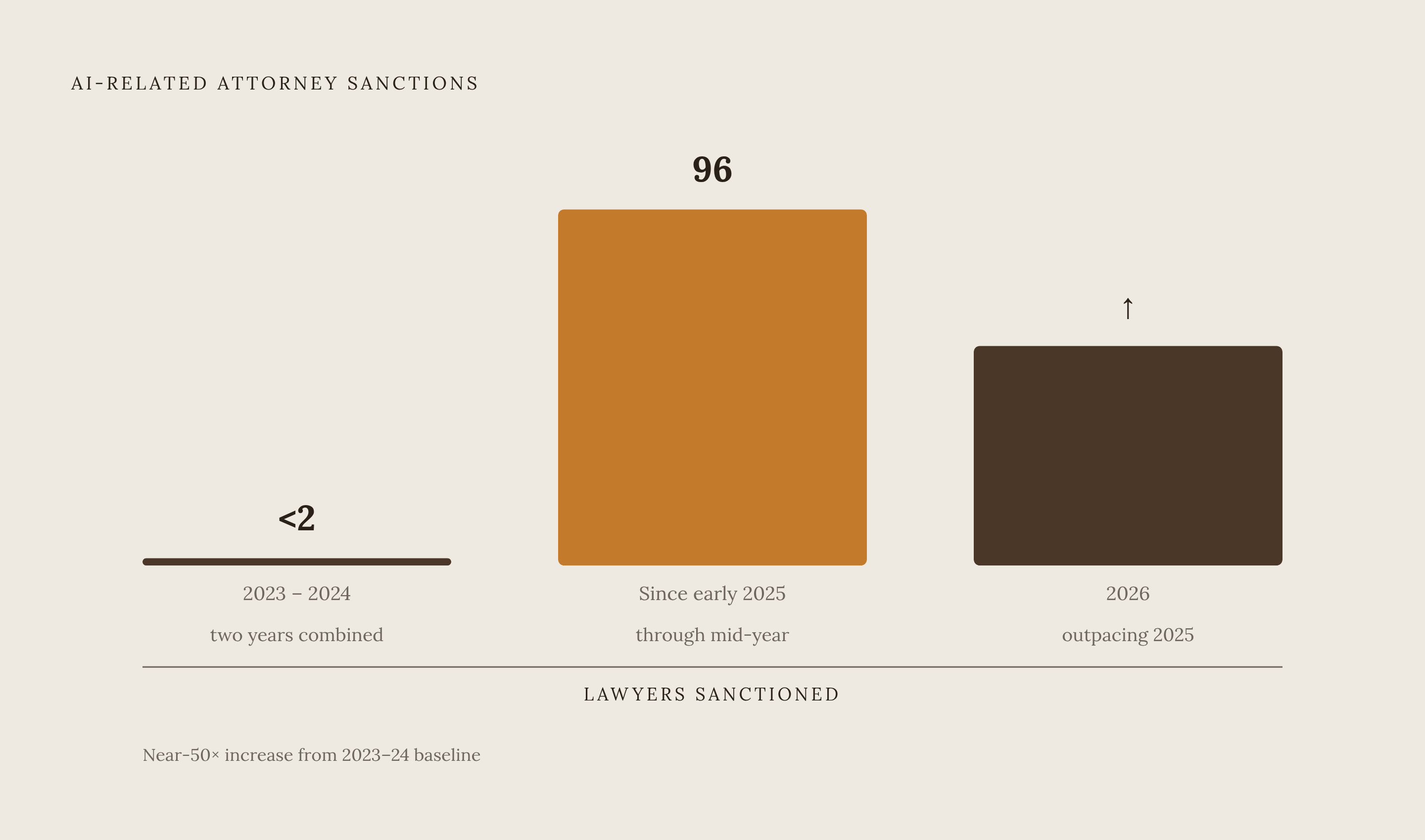
Since early 2025, 96 lawyers have been sanctioned for AI misuse, compared with two in the two prior years combined. Sanctions in 2026 are outpacing 2025 at the same point in the year. The consequences extend well beyond monetary penalties.
Judge Sharion Aycock sanctioned attorneys on both sides of a Mississippi federal breach-of-contract case for “blindly relying on technology.” The consequences included disqualification and a two-year bar from appearing before that court. An Alabama federal judge reprimanded three Butler Snow attorneys and referred them for bar discipline because they used AI-fabricated citations in prison litigation. The judge also required disclosure of the sanctions to clients, opposing counsel, and other judges, extending the repercussions beyond the filing itself.
A chief judge in the U.S. District Court for the Western District of Michigan raised concerns about a U.S. DOJ filing that cited the nonexistent case Taylor v. Hott, apparently generated by AI. The filing led to a warning but no sanctions. At the other end of the firm-size spectrum, the U.S. Court of Appeals for the 11th Circuit referred a Sabatini Law Firm P.A. attorney to its Committee on Lawyer Qualifications and Conduct for briefs containing fake, AI-generated citations. The court treated the conduct as a violation of duties to both client and tribunal.
Across these cases, the recurring failure is the same. Attorneys treated generated text as finished work, though it was a draft that needed independent verification. The pattern spans opposing sides, government lawyers, and private firms, which makes it difficult to dismiss as a problem confined to one practice setting. A study led by a university found that leading legal AI research tools had high hallucination rates in the conditions it tested. That finding places verification at the center of deployment because unsupported output is a structural risk of the tools.
The duty-of-competence paradox: liability for using AI carelessly and for not using it at all
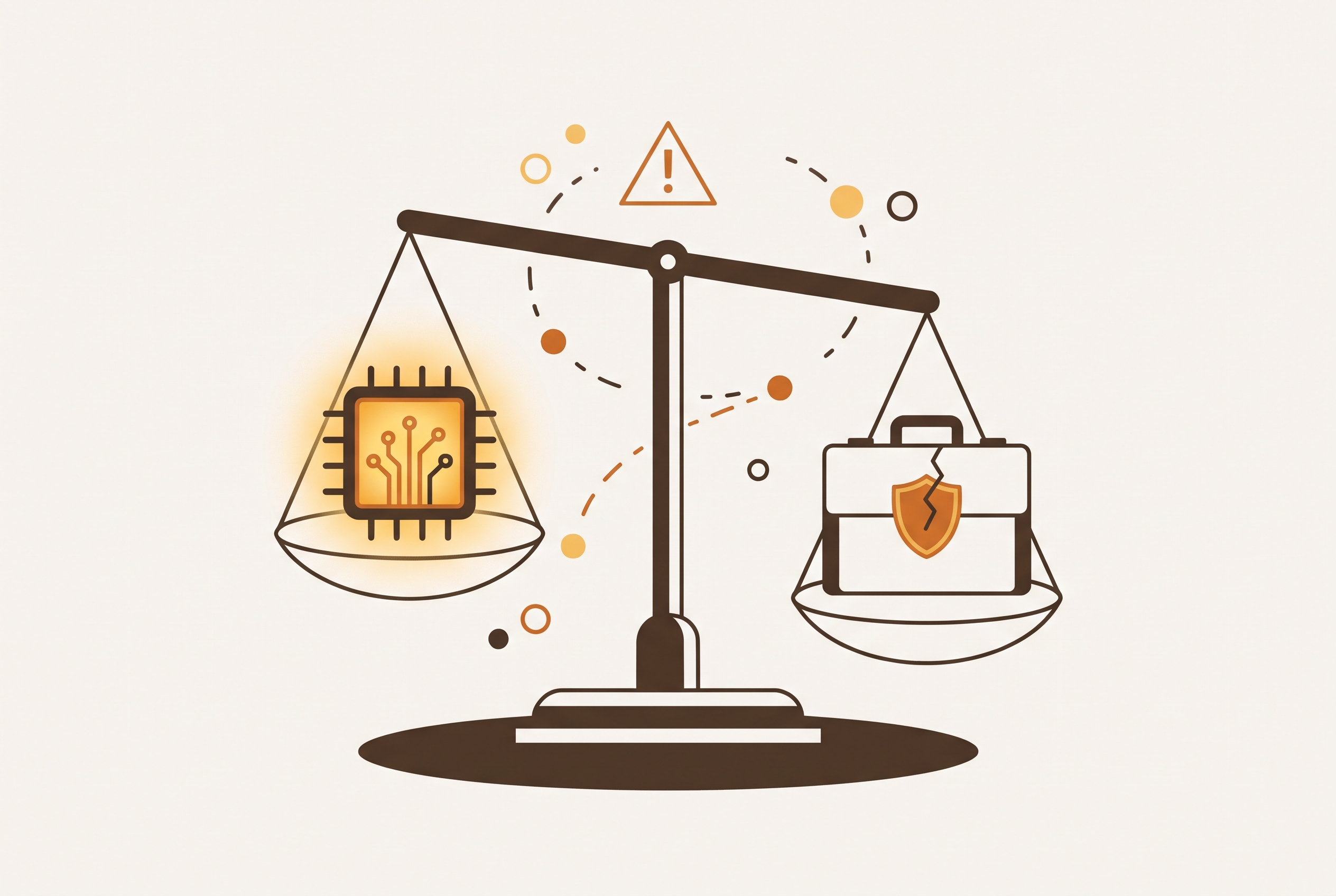
ABA Model Rule 1.1 requires lawyers to maintain technological competence, while careless use can expose them to sanctions and malpractice claims. The resulting pressure runs in both directions. A firm must understand how a tool can improve its work and where reliance on that tool can undermine it.
Consider the potential failure on the nonuse side. If opposing counsel uses advanced AI tools to find controlling precedent that a manual researcher misses, and that omission harms the client’s case, a malpractice action can follow. That possibility means abstention can still expose a firm to liability when the adequacy of the legal work is challenged.
BakerHostetler reported that using AI-powered legal research cut the hours spent on research by 60%. Salesforce’s internal legal-ops team uses an AI agent to draft, redline, and analyze contracts, cutting spending on work that used to require outside counsel. These examples establish more than a potential speed advantage. They show why clients are beginning to benchmark both the cost of AI-assisted legal work and the time it should take.
Attorneys still owe clients competent work, whether they fail by trusting a generated authority or by missing a controlling one. Governance provides the means to pursue the operational benefit without treating speed as proof of quality. It also gives the firm a basis for explaining why a tool was suitable for a task and how its output was reviewed.
ABA Formal Opinion 512, issued July 29, 2024, applies those duties to generative AI through Model Rules 1.1, 1.4, 1.5, 1.6, 3.1, 3.3, 5.1, 5.3, and 8.4(c).
What the bar rules and state statutes now require firms to document
Formal Opinion 512 supplies the ethical foundation for AI use, but ethics opinions are no longer the only source of obligation. Competence, confidentiality, supervision, candor, and reasonable fees now sit within a wider set of court requirements and state statutes. The layers reinforce one another. A weakness in supervision can become relevant to a disciplinary proceeding, a court’s scrutiny, and an insurer’s assessment of the firm.
Rule 1.6 makes entering client information into a public model a confidentiality issue before it becomes a security issue. Public LLM APIs can jeopardize privilege if the data is used for training. Legal enterprises are shifting toward private cloud-hosted environments for that reason. Multiple jurisdictions have also issued formal bar opinions on AI. Firms must also follow separate court orders on how lawyers use AI.
Texas TRAIGA took effect January 1, 2026, with civil penalties up to $200,000 per uncurable violation and NIST AI RMF compliance operating as an affirmative defense. Utah’s AI Policy Act, SB 149, became law in force on May 1, 2024. Its high-risk interaction category, which expressly reaches legal, financial, medical, and mental-health advice, came through the 2025 SB 226 amendment, effective May 7, 2025.
Timing is part of the compliance obligation. Colorado’s SB26-189, signed May 14, 2026, repeals and reenacts SB 24-205 with a January 1, 2027 effective date. The EU AI Act entered its full enforcement phase in August 2026, adding compliance obligations for firms doing business in Europe. State bars have also begun signaling, and in some cases initiating, disciplinary action over improper AI use.
For firms, the documentation consequence is practical rather than uniform. These authorities do not prescribe one identical record, but policies, training records, review procedures, and audit trails can show how the relevant obligations were addressed. Insurers increasingly seek evidence of those same controls.
Where malpractice insurance coverage actually stands on AI claims
Most firms operate with what insurers call “silent” AI coverage. Their professional liability policies were written before generative AI existed and have not been amended to address it. Whether those policies cover an AI-related claim may remain unresolved until a claim is filed. That uncertainty exists now, even for firms that have never discussed AI with their carrier.
As of mid-2026, no major U.S. lawyers’ professional liability carrier had publicly filed a blanket, named AI exclusion on its standard policy form. That absence leaves the treatment of AI-related claims open to dispute under existing language. A policy without a named exclusion and a policy expressly covering AI risk are different propositions.
Stan Sterna at Aon’s AICPA Member Insurance Program said in April 2026 that professional liability underwriters are asking, “Do you use AI? Do you police it? Do you have protocols in place?” Unlike cyber underwriters, they do not yet use a standardized AI question set. Firms cannot assume that an unchanged policy means an unchanged assessment of their practices.
Nine-figure losses are no longer considered unusual outliers, so AI claims are entering a market already moving toward higher severity. A small affirmative AI coverage market has emerged through explicit endorsements conditioned on documented governance practices and an AI risk assessment. Most firms are not yet actively pursuing that coverage and remain on silent coverage by default.
A firm facing an AI-related malpractice claim may also have to establish that its existing policy responds to the loss. The firm can face two simultaneous disputes, with no guaranteed outcome in either.
What governance practices actually reduce exposure across all three risk layers
The first control is a written firmwide AI policy. Al Roberts of Berkley Select advises firms to identify approved tools, permissible uses, and required review procedures rather than leave those decisions to individual attorneys. That policy supports supervision while giving bar authorities and underwriters evidence of governance. For a firm preparing to expand AI use, the practical requirement is to make those rules explicit before adoption spreads.
Verification must then become a required part of delivery. Chris Newbold of ALPS states that attorneys “own the judgment, the verification and the work product” when using AI. The corresponding practice is to treat generated text as a draft and independently verify every citation, quotation, factual statement, and legal conclusion against Westlaw, Lexis, or CourtListener before court filing or client delivery. Wisner Baum has implemented in-house tools for specific legal tasks, including identifying hallucinated authorities in briefs before filing. Crawford Appleby of that firm states, “Disclosure rules alone do not solve the problem. What matters most is that firms and courts have screening systems in place and that lawyers treat verification as mandatory, not optional.”
Confidentiality controls must govern inputs as well as outputs. Roberts advises closed or controlled environments to prevent client information from being disclosed, retained for training, or exposed outside the firm. Newbold cautions against placing confidential information in free, publicly available AI platforms. Training completes that control. Tom Martin of CiteCheck AI identifies understanding AI capabilities, limitations, and applicable ethics requirements as prerequisites for use, while Roberts emphasizes the requirements of every jurisdiction in which an attorney practices.
To qualify for affirmative AI coverage, firms need records of their governance, an AI risk assessment, training records, and an audit trail. The efficiency objection is nevertheless real. Legal tasks achieve only a 1.4x AI productivity gain because governance review consumes much of the speed advantage. Firms need fast, reliable, systematic verification to address manual, inconsistent review and the greater exposure to disqualification or bar referral that faster delivery can bring.
Before scaling, the lesson is to conduct an AI operations audit. Regulated-industry deployments that reach production share deterministic execution, with reproducible, explainable, and auditable outputs, data sovereignty, and governance controls built in from day one. Those controls include RBAC, audit trails, approval workflows, and version control. A scored readiness assessment across strategy, data, infrastructure, governance, and use-case ROI gives the firm a documented baseline for underwriters, bar examiners, and courts. Readiness audits can also materially reduce project cost overruns, making assessment a production safeguard. In legal practice, audit-first deployment is the professional counterpart of the readiness discipline required before scaling AI in a regulated industry.