
Essay AI Deployment
Change Management for AI Adoption in Law Firms
Law firm AI succeeds only when incentives, workflows, and accountability change together.
AI adoption in law firms is an organizational transformation. Its success depends on changing incentives, workflows, professional development, and accountability together. Firms that treat change management as a strategic discipline can turn individual experimentation into governed, measurable improvements in legal work. Firms that treat it as an afterthought leave the underlying business unchanged while adding new risks.
Why AI adoption keeps failing in law firms despite widespread enthusiasm
Thomson Reuters Future of Professionals 2026 documents a large share of law firm professionals using AI tools their firms have not authorized. Adoption is already happening outside institutional controls. That shadow use exposes client information and legal work to operational and compliance risks that an approved deployment is supposed to address. Firms therefore need to close the gap between what individuals already do and what the firm can responsibly support.
That gap reveals a failure of leadership and strategy. Enthusiasm for AI among lawyers does not set rules for its use, decide who must review the work, or settle how it will change their chances to grow in their careers. Lawyers can welcome help with a task while resisting changes to the professional and commercial model around it. Without governance, that experimentation accumulates unmanaged risk.
What law firms' own economics do to AI adoption before it starts
In hourly-billing environments, completing work faster can reduce the time available to bill, creating a direct disincentive to use tools that accelerate delivery. The leveraged associate pyramid adds to that tension because routine work has long brought in revenue while training junior lawyers. AI disrupts both functions at once. A partner evaluating adoption is therefore weighing more than software performance, because the same efficiency gain can unsettle revenue and the talent pipeline.
This is an innovator’s dilemma within the firm. A profitable model makes disruption difficult to justify even when thoughtful risk-taking could strengthen the business. A typical rollout assumes that users and leaders both gain when work becomes faster or easier. That assumption does not transfer cleanly to legal practice. Unless the commercial implications are addressed, apparent resistance to a tool may reflect a rational response to the incentives surrounding it.
An ABA Formal Opinion tells lawyers to check AI-generated work under the existing Model Rules of competence and candor. Lawyers still have duties of confidentiality, supervision, and attorney-client privilege when AI handles client matter data. These obligations belong within the workflow itself. An adoption program that leaves them unresolved can stall at the first ethics question, regardless of how useful the technology appears. Together, billing incentives and professional duties make legal AI change management a distinct discipline rather than a standard enterprise deployment with additional training.
The external pressure making the internal hesitation costly
The Thomson Reuters report finds that a large majority of in-house legal professionals expect outside firms to change their commercial models as AI usage increases. Only a small fraction of firms have altered their pricing structures in response. That mismatch has consequences for client retention. A material share of in-house professionals are already reconsidering, or expect to reconsider within 12 months, firm relationships that do not deliver AI-enabled value.
Clients who use AI in their own legal departments can draw on that experience to judge those results. They can check whether outside counsel’s work and invoices show that firms can do what they claim. Tool access alone is not a differentiator. As competing products converge, the stronger commercial distinction is whether adoption changes how legal work is performed and billed.
The report finds that a significant share of professionals using professional-grade AI tools would decline a job offer that did not include them. A gap between expected and actual AI value is also prompting consideration of departure. Senior leaders significantly underestimate these client and talent pressures. Their perception gap can delay decisions precisely when the people buying and delivering the firm’s services are becoming less willing to wait.
Why change management fails even when firms know they need it
Firms often treat change management as communications attached to a completed technology deployment, after decisions about tools and workflows have already been made. Stakeholder fatigue, unclear ownership, workflow disruption, trust concerns, and difficulty proving value then obstruct adoption. These are organizational failures. A launch message cannot settle who is in charge of a process or whether using it will hurt a lawyer’s standing.
The perceived loss is often personal and professional. Lawyers may fear losing competence, confidence, autonomy, status, or part of their professional identity when established work changes. Training that explains a feature does not address those concerns. Nor does it create the habits needed to use that feature reliably in live work. A budget covering licenses and a single training session funds access but leaves practice, continuing support, and adaptation largely unsupported.
Uniform implementation creates another source of friction. Litigation professionals, HR teams, and finance functions have different priorities, so a single adoption message cannot explain the value of every workflow. Yet firms often judge success by how many seats have been activated or how many people have finished training, which makes those differences hard to see. Access becomes a misleading proxy for adoption. When leadership then treats launch as the project’s endpoint, unresolved barriers remain in place while the profession’s caution toward unfamiliar work patterns sets the default.
Enthusiasm for AI among lawyers does not set rules for its use, decide who must review the work, or settle how it will change their chances to grow in their careers.
What a strategy-first change management framework actually requires
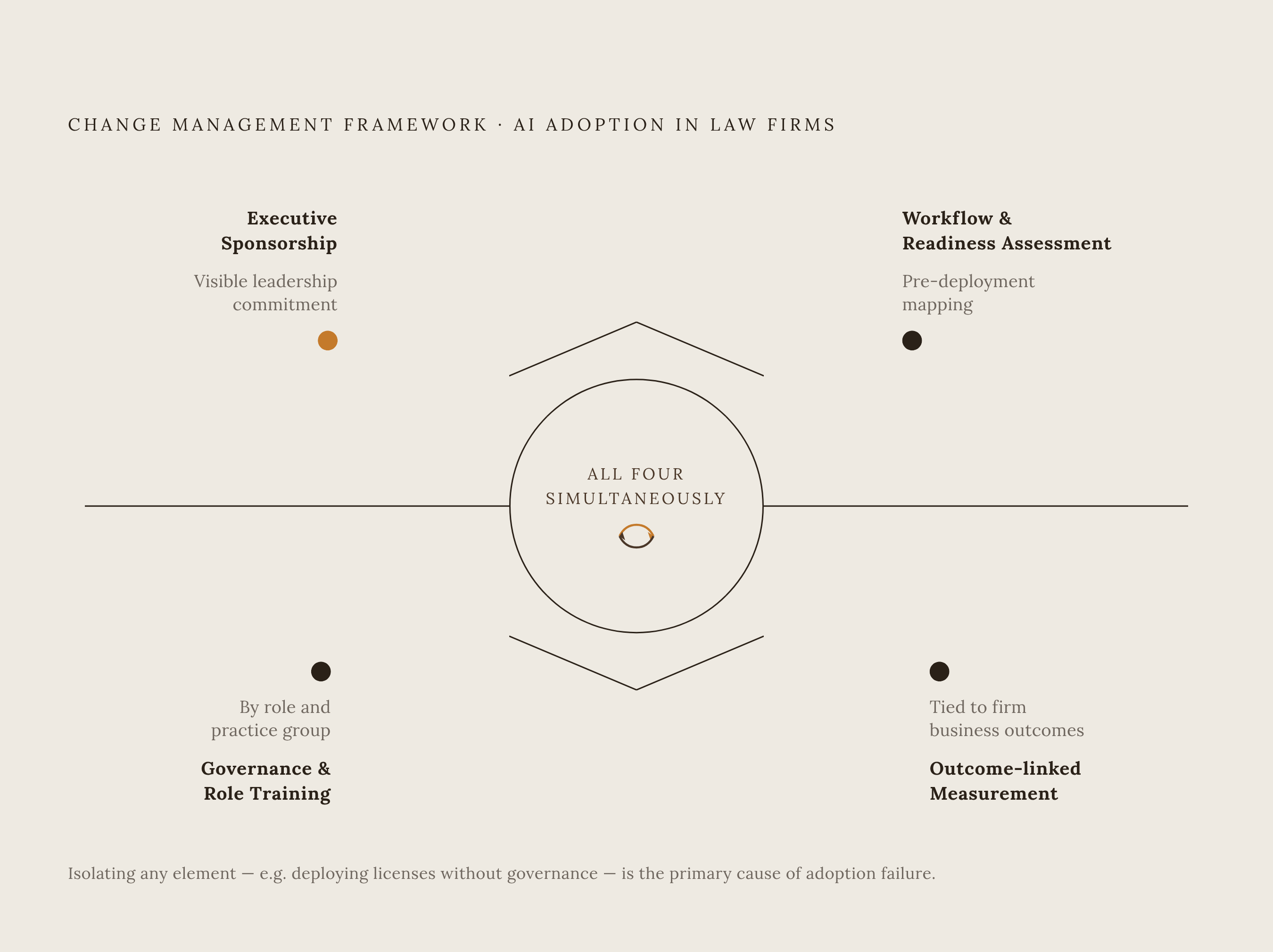
The response requires four interlocking elements built together, namely visible executive sponsorship, pre-deployment workflow and readiness assessment, role-specific governance and training, and measurement tied to business outcomes. Visible sponsorship starts when leaders do what they ask others to do, going beyond their approval of budgets. Partners or department heads who dismiss an initiative in private can weaken it even if they have backed it formally. Unqualified enthusiasm creates the opposite risk by encouraging use without boundaries. Leadership must make both expectations explicit, that innovation is expected and that it must be responsible and governed.
That sponsorship must also address the perceived threat to professional development. Associates need a credible explanation of how AI can accelerate their careers. Training investment gives that message practical substance. Without it, reassurance remains disconnected from the experience of learning new work. Leaders must therefore support adoption in ways that make development prospects visible and help associates reconcile efficiency demands with expectations about their value.
Firms should map how people actually do the work, including informal workarounds, instead of relying on how leaders say the process should work. Those workarounds can reveal slow or misaligned systems and places where AI may gain traction. Discovery must precede dependence on the tool. Before deployment, the firm needs to establish what data the system will access, which outputs require human review, and where governance is missing.
A formal AI Operations Audit sets out what this discovery will cover. It assesses data quality, permissions, security, integration, ownership, and ongoing operating cost before a pilot becomes a production dependency. For a law firm, that readiness assessment must also address document confidentiality, privilege architecture, and bar compliance. These are not separate questions for a later review. A proposed workflow’s suitability for client matter data and sustainability beyond experimentation depend on these conditions.
Role-specific governance and training then translate that assessment into daily practice. Users need instruction on relevant use cases and how tools fit into their existing work, with continuing opportunities to ask questions, share experiences, and learn from peers. Governance must be operational before deployment begins. Policies, restrictions on client and confidential data, review processes, and human oversight protocols must establish where technology ends and professional responsibility begins. Transparency with clients about AI use and safeguards reinforces that boundary while supporting trust.
Firms must measure whether these changes bring results for the business. The partnership can judge the results of adoption by how much faster matters are delivered, how pricing models change, how much less time associates spend on routine tasks, and what clients say about their satisfaction. Activated seats and training completion cannot answer that question. A measurement plan should make it possible to distinguish a widely available tool from a changed way of working. The Thomson Reuters report identifies operationalizing AI, rather than talking about it, as the source of competitive advantage.
Where agentic AI changes the governance stakes in legal workflows
Agentic AI raises the stakes because systems are already executing legal workflows without per-action human review in a meaningful share of firms and legal departments. Governance must cover more than checks on generated content. It includes defining what an agent is authorized to do and how the organization responds when an action needs to be reversed. The discipline established for today’s tools provides a foundation for those decisions. It cannot, however, substitute for explicit controls suited to autonomous action.
A majority of respondents described their organizations as “agentic ready,” yet only a small fraction met all the stated criteria, including written authorization policy, rollback protocols, stale-context failure testing, and vendor liability terms. Operational readiness requires those controls to exist. Governance built before deployment makes that distinction possible before an agent becomes part of legal production.
A large majority of respondents with executed vendor contracts for agentic functionality reported standard limitation-of-liability clauses capping exposure at prior-year fees paid. Only a small share had agreements distinguishing agentic-action errors from generative-output errors. The risk the firm retains under its contract makes vendor liability terms part of operational readiness.
The broader enterprise pattern reinforces the distinction between commitment and readiness. Across US enterprises, a majority had funded at least one AI agent project in a recent period, while far fewer had one in production. Funding does not establish operational readiness on its own. For law firms, the lesson is to establish authorization, oversight, recovery, and contractual accountability before agentic workflows go live. That preparation enables responsible deployment rather than requiring governance to catch up with autonomous action.
What the talent and commercial model must look like on the other side of transformation
AI adoption ultimately changes the model of legal work itself. The Thomson Reuters report finds that a significant share of respondents expect new AI-specialist and legal technologist roles, together with reductions in paralegal and support roles. Firms can plan for that shift or confront it reactively. The choice affects how they develop expertise as well as how they allocate work. Change management gives those staffing decisions a place within the firm’s strategy rather than leaving them as disconnected responses to automation.
Associate development requires equally deliberate redesign as lower-level tasks become automated. New lawyers still need to build critical thinking, judgment, and client relationship skills even when routine work occupies less of their time. Efficiency alone does not provide that education. Evolved training strategies must preserve the development of professional capability as the work supporting it changes. The disruption to billable hours therefore creates an opportunity to reconsider both how lawyers learn and how much leverage the firm can generate.
Alternative fee arrangements are becoming a competitive necessity as in-house clients use their own AI capabilities to benchmark speed and cost. Firms that have already restructured pricing are better positioned to retain those relationships. Sustaining that position requires dedicated people and ongoing accountability for change. The enduring advantage will belong not necessarily to the earliest adopters, but to firms with the organizational capacity to keep adapting their governance, talent, and commercial model as the technology evolves.
Notes
- Future of Professionals - 2026 Legal Report
Supplied the findings on unauthorized AI use, in-house client expectations of pricing change, talent pressures, and expected shifts in legal roles.
- Driving Real AI Adoption Across Your Firm
Informed the argument that adoption fails when change management is treated as an afterthought, covering seat counts as a misleading metric, role-specific training, executive sponsorship, and associate development.