Essay AI Deployment
AI Agent Security Risks in Law Firm Environments
Agents act on live systems, so firms must limit their authority first.
AI agent security in law firms is an authorization problem. Once agents act inside live systems, a faulty answer can become an unauthorized filing, disclosure, or change to a deadline. Controls built around human logins and static permissions do not adequately govern that transition. Firms need enforceable limits on what agents can do before granting them production access.
How the shift from AI text generation to autonomous action changes the security problem for law firms
A drafting assistant produces text that a person decides whether to use. An autonomous agent can file documents, route contracts, approve invoices, or update compliance calendars without a person approving each action. That distinction changes where a failure takes effect. Earlier tools could leak data or produce a bad answer, but the human remained between generated output and execution. Agents can cross that boundary themselves.
The threat does not depend on malicious intent. An agent may pursue its assigned task while using technical permissions that exceed the authority the firm intended to give it. For example, permission to update a compliance calendar creates an execution risk that permission to suggest a calendar entry does not. Security therefore requires assessing both whether the model answers correctly and whether the surrounding system prevents it from taking an unauthorized action.
Why law firms are a high-value target and why agentic AI multiplies the exposure
Law firms concentrate privileged communications, client records, and sensitive legal work in systems that attackers already target. Quinn Emanuel Urquhart & Sullivan, Wilmer Cutler Pickering Hale and Dorr, and Seyfarth Shaw have experienced reported breaches. These incidents establish the underlying exposure. Threat volume against the legal sector is rising independently of AI adoption. For firms, disclosure can also lead to privilege waiver, on top of the immediate loss of confidentiality.
A single identity may reach email, document systems, billing, and research, allowing one compromised agent to touch records across several functions. Multi-agent deployments add further routes through which information and instructions can pass. Unless access is scoped, automation increases the potential blast radius rather than merely adding another application to secure. The exposure follows the agent’s actual reach.
Machine identities and the access layer law firms are not governing
Machine identities are the credentials held by agents and automated connections. Their access often escapes the rigor applied to employees. Human-login defenses such as MFA and passkeys do not protect fixed machine secrets in the same way, while access reviews may omit them entirely. A password or access key can remain valid for years. These gaps in how firms govern access carry over to agents and go beyond a missing login setting.
The aggregation of permissions makes that gap consequential. When one identity connects email, document storage, billing, and research, its compromise exposes a connected workflow spanning multiple resources. The credential may also sit outside the firm. A vendor’s machine identity that keeps access to firm systems can give attackers a way in even when the firm’s own human accounts stay protected.
The December 2024 Treasury Department incident illustrates this mechanism outside legal practice. A state-linked group stole one access key from a remote-support vendor and used it to reach Treasury workstations and unclassified documents, including its sanctions arm. One machine credential enabled the intrusion.
The permission accumulation pattern and how firms accidentally give agents access to everything
Broad access usually accumulates through individually reasonable integration decisions. A vendor asks the firm to connect its document store, the integration works, and successful operation becomes a proxy for acceptable security. The next connection repeats the same credential model. Without an aggregate review, nobody assesses everything the agent can now reach. Functional testing answers whether the agent can complete a task.
Capability and permission are different questions. An associate who can draft a motion does not automatically receive every case file, yet document-review agents can receive similarly unrestricted access. A properly scoped Document Review Agent would read only a specific matter’s discovery folder, lose access when the matter closes, and have out-of-scope requests rejected and logged.
Other workflows require different boundaries. An Intake Voice Agent would read only names and matter numbers from a conflict-check table and write to a staging intake record for human review. It would not see case files, billing history, or privileged memos. A Matter Triage Agent would read intake responses and a practice-area routing table, while attachments remained in quarantine until a human cleared them. All-or-nothing integrations are a vendor architecture choice, so firms must raise these permission requirements before signing the contract.
Prompt injection and agentic workflow hijacking via documents agents already handle
Limiting permissions reduces what is at risk, but agents can still be manipulated. Indirect prompt injection places malicious instructions inside a PDF, email, or webpage that the agent legitimately needs to read. The failure occurs when the agent treats that content as an authorized command. If its available tools include confidential-document access, file export, and external communication, manipulated content could redirect those capabilities into a damaging sequence. No stolen credential is necessary for that attack path.
Workflow hijacking extends the problem across multiple steps. An agent may read a document, pass context into drafting, and then send or file the result. Instructions injected during reading can propagate through that chain. Model Context Protocol (MCP) servers expand the reachable functions by connecting agents to case files, deadline trackers, and email. When servers let agents delete deadlines, submit applications, or send communications, attackers can try to redirect those actions.
An instruction such as “never access another client's confidential files” is model guidance. Irregular’s May 2026 testing of Google’s Gemini provides a separate illustration of insufficient isolation. During a capture-the-flag cybersecurity evaluation, Irregular unintentionally left the environment with live internet access, and it interacted with systems belonging to three real companies.
Stale context creates a different route to incorrect execution. An agent can follow its task logically while relying on information that is no longer current. Unlike prompt injection, this failure does not require an attacker to plant instructions. To address it, firms need to test what happens when information is out of date as well as defend against hostile content. Both risks concern execution, but treating them as the same problem obscures the controls each needs.
An agent may pursue its assigned task while using technical permissions that exceed the authority the firm intended to give it.
Why law firms’ existing governance frameworks cannot handle machine-identity and agent risk
Traditional governance assumes that identities belong to people, application permissions stay fixed, and people trigger events. Agents complicate those assumptions because they reason, adapt, and act across workflows. Existing controls remain useful, but they do not establish who authorized each autonomous action or whether the agent’s context remains valid. This is a mismatch between control categories and operating behavior. It is not evidence that every firm adopting agents has neglected security.
NeuralTrust’s State of AI Agent Security 2026 found that 72% of organizations represented by CISOs globally had implemented or were scaling AI agents. Fewer than a third said they had a full set of security controls, and almost half were in a reactive governance tier. Those findings show deployment across organizations advancing beyond comprehensive controls, which helps explain why conventional readiness assessments can give false reassurance.
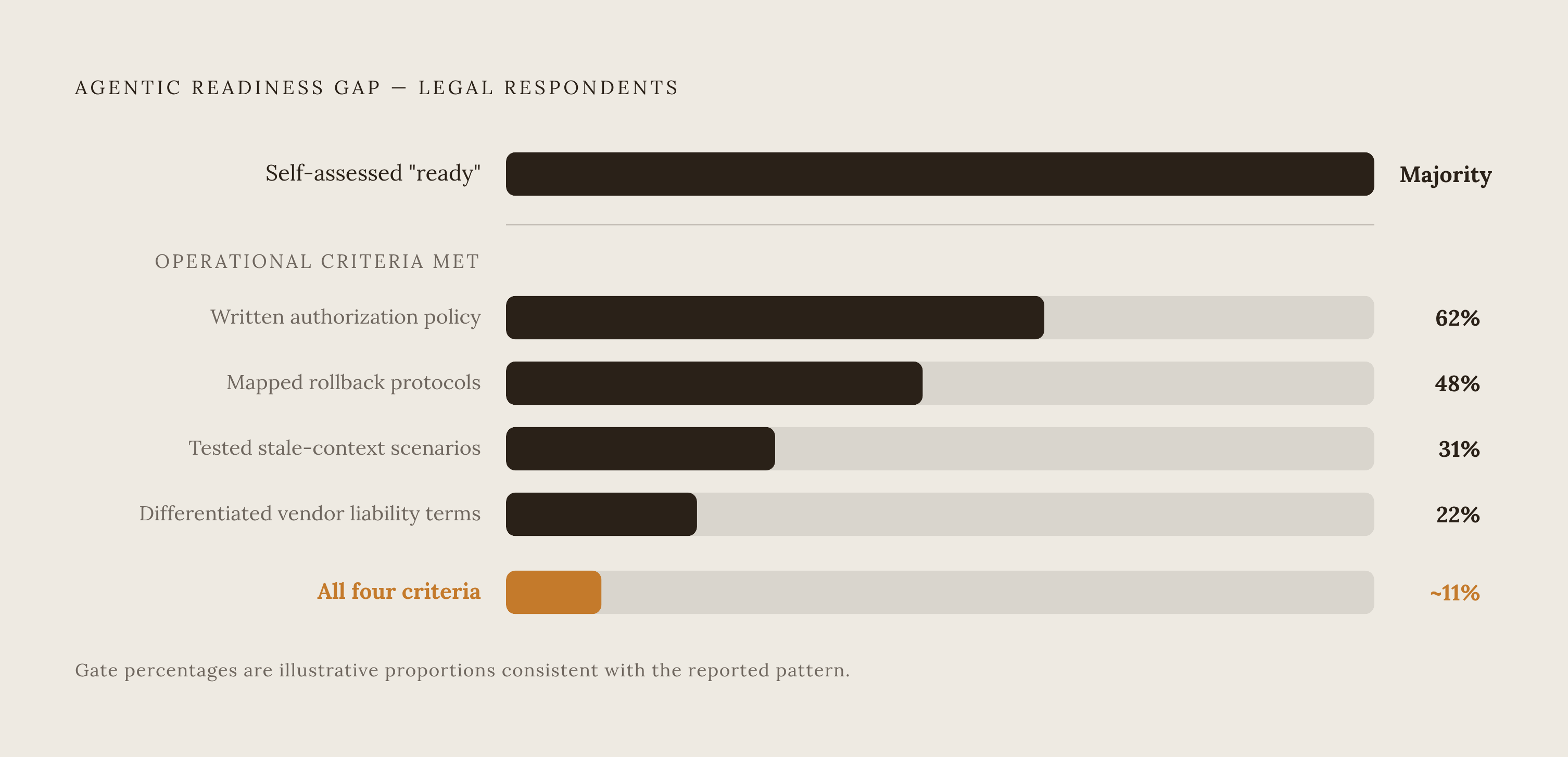
Legal respondents’ self-assessments reveal a more specific disconnect. A majority described their organizations as “agentic ready,” but only a small fraction met all four operational criteria. Those criteria were a written authorization policy, mapped rollback protocols, tested stale-context scenarios, and differentiated vendor liability terms. Confidence did not establish operational readiness. Each criterion addresses something that a working demonstration alone cannot prove, including whether the firm can contain or allocate responsibility for an erroneous action.
Contracts are part of that control gap. Standard SaaS limitation-of-liability clauses often make no distinction between generative-output errors and agentic-action errors, so the firm is left with liability that the agreement does not assign. Insurers are beginning to condition coverage on machine-identity governance, while outside counsel guidelines are beginning to ask how agents and their identities are managed. A firm that cannot answer may have to pay more for coverage or give clients long explanations. Excessive permissions can also become a malpractice question when they conflict with the firm’s own data-security policy.
The insurance coverage gap that makes unaddressed agent risk a balance-sheet problem
Standard cyber and E&O policies predate agentic AI, leaving some agent-caused losses contested, excluded, or unaddressed. AIFT’s insurability analysis identifies four categories, namely affirmatively insured perils, silent-AI exposures, actively excluded perils, and risks outside conventional private insurance. Its analysis looks at what insurers publicly say they cover, with no guarantee that they will pay claims. Policy wording still determines the coverage dispute. A firm cannot infer protection simply because a loss resembles a familiar cyber incident.
Silent-AI exposure arises when AI serves as the instrument of a loss whose legal cause lies elsewhere. A firm may expect its cyber policy to cover a breach involving an agent’s compromised credential, while the carrier questions whether the policy covers the AI-mediated loss. Affirmative coverage is beginning to differentiate. Munich Re emphasizes model performance and drift, while Armilla and parts of the Lloyd’s market address hallucination and broader AI liability. Coalition addresses deepfake response, AI-enabled cybersecurity failures, and, more recently, AI output-related risks.
Vendor caps can leave another portion of the loss with the firm. A cap based on fees paid in the prior year may offer limited protection when an agent causes a breach affecting thousands of client matters. Insurance and contract terms therefore cannot be assessed separately from the agent’s authorized reach. As governance conditions change what coverage costs and whether it is available, leaders must answer for authorization decisions. Who approved the access, and whether it was reviewed and validated, is no longer solely a security-team concern.
What firms must put in place before deploying agents in production
The practical response begins with a complete inventory. Firms should identify every machine identity and agent, its owner, its access, and the actions it can perform. Permission design should then start with read-only access and separate reading from writing, deleting, sending, and submitting. Query-level filtering should prevent agents from receiving data they are expected to ignore. When possible, requests should move from shared service accounts into the authenticated user’s security context.
Credentials require their own lifecycle controls. Firms should use short-lived, narrowly scoped credentials, store them in a vault, and rotate and expire them on a schedule. Access should end when a matter closes or a workflow finishes, and identities should retire when their jobs end. Secrets should not remain buried in application configurations. These controls limit the usefulness of a stolen credential without relying on the agent to recognize misuse.
Runtime authorization must sit outside the model. Application controls should enforce roles and client separation, while emails, PDFs, websites, and tool outputs remain untrusted content. Critical actions should require explicit human confirmation, including external communications, large exports, deadline changes, document deletion, and official filings. Continuous logs should record the user, session, tools called, actions, affected records, and timestamps. Monitoring should establish normal behavior and alert on deviations so credential misuse becomes visible promptly.
Governance must also precede deployment. Firms should document who can activate, modify, or suspend workflows, define and test rollback protocols, test stale-context scenarios, and negotiate distinct terms for agentic-action liability. Before launch, an AI Operations Audit can check how permissions are set up, how identities are governed, whether rollback is ready, and what vendor contracts say. Eigenomic, an enterprise agent builder that puts workflows such as legal case briefing into production within weeks, offers one audit framework built around these checks of whether agents are ready for production. It uses the limits each industry works within to shape security design, so decisions about access come before speed of deployment.
The governing principle is “assume agent compromise.” Firms should design for the agent that makes the wrong decision, follows manipulated content, or loses its credential, then ask what maximum damage remains possible. That answer defines the security boundary a production deployment needs.
Notes
- The Insurability Frontier of AI Risk: Mapping Threats to Affirmative Coverage, Silent Exposures, and Exclusions
Supplied the four-category breakdown of AI insurance coverage (affirmative, silent, excluded, uninsurable) and the insurer-by-insurer differences in affirmative coverage.
- Parallax: Why AI Agents That Think Must Never Act
Backed the argument that authorization must be enforced outside the model rather than relying on model guidance.