Essay Legal Workflow Automation
Legal AI for Deposition and Hearing Preparation
AI expands deposition prep capacity while demanding attorney oversight of every generated stage.
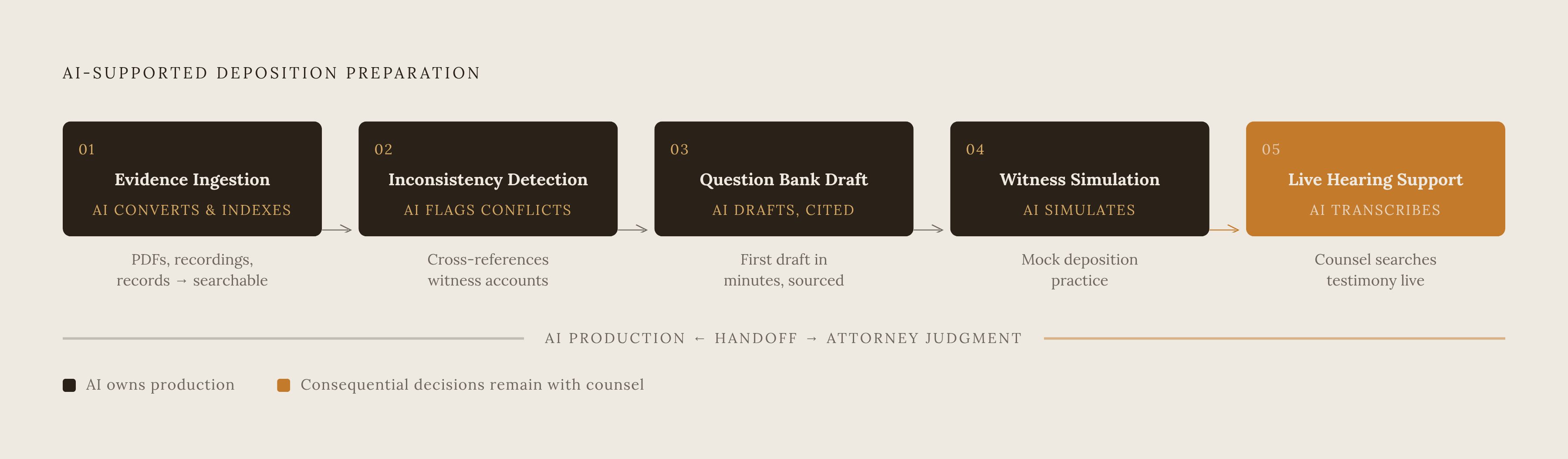
Legal AI for deposition and hearing preparation now extends beyond transcript search into evidence organization, inconsistency detection, question drafting, simulation, and live support. Its value comes from connecting those stages into a governed workflow. Attorneys still set the strategy and answer for the work while AI handles set stages of preparation.
What deposition preparation actually requires — and where the time goes
Deposition preparation begins with reading across pleadings, interrogatories, prior transcripts, witness statements, exhibits, medical records, and expert reports. Attorneys and paralegals must use those materials to build a case timeline before deciding which facts to ask about. A question needs an evidentiary basis, while a prior statement must remain traceable to a page and line. As the outline develops, the team must also identify exhibits, anticipate objections, and prepare witnesses for cross-examination pressure.
Verbit's 2026 guide describes preparation as encompassing discovery review, a detailed outline, and witness coaching that includes mock depositions. LegalEase Solutions' case study identifies the drafting burden within that process, including finding relevant facts, organizing questions by topic, sequencing and numbering them, and retaining their supporting evidence. Each step draws on the preceding work. The resulting outline must leave room for improvisation without losing its connection to the core case theory. That tension makes preparation more demanding than compiling a list of questions, even when an experienced litigator knows the case well.
How AI takes over the evidence ingestion and organization layer
AI changes the starting point by converting unstructured evidence into material that attorneys can search and navigate. The inputs extend beyond text to recorded phone calls and body cam footage, as well as PDFs, scanned exhibits, prior deposition transcripts, and medical records. Verbit's guide describes AI transcription tools that turn digital evidence files into searchable written records. Instead of keeping those recordings separate from written discovery, the team can work from a more usable foundation.
AI-powered platforms support keyword searches and structured chapter headings, allowing attorneys to navigate directly to relevant passages. Digital annotation tools let teams highlight transcripts and mark follow-up questions in the document. The document itself becomes the working reference. This layer automates the multi-hour paralegal task of indexing discovery packets and cross-referencing deposition exhibits, giving the attorney structured material ready to query. Its contribution at this stage is access and organization, before any substantive comparison or drafting begins.
Inconsistency detection across witnesses — what AI finds that manual review misses
Once testimony is organized, AI can compare what different witnesses said as well as find single passages. A litigator reading transcripts sequentially may miss a conflict that becomes apparent only when two statements about the same event appear side by side. Memory becomes a constraint across large discovery sets. Deposition-focused AI platforms perform multi-witness cross-referencing as a designed function, flagging where one account conflicts with another on a shared event or fact. That expands the attorney's field of vision without deciding what the conflict means.
Search and comparison serve different roles here. Finding a passage establishes what a witness said, while comparing accounts exposes where the evidence may not align. Verbit's guide describes ready access to prior statements and transcripts as a way to challenge inconsistencies and validate case facts. When a conflict surfaces before the deposition, the attorney can use it to construct targeted questions with the relevant testimony at hand. A conflict discovered only during questioning is harder to exploit cleanly because the attorney must assess it while managing the session. AI's analytical contribution is therefore not a substitute for judgment, but a broader evidentiary basis on which to exercise it.
From evidence map to question bank — how AI drafts the deposition script
LegalEase's Litigation Workflow Assistant makes the move from evidence analysis to draft production concrete. Built for a U.S. litigation attorney, it generates a source-referenced first draft of a deposition script in minutes, grounded in the case file. The system learned from the attorney's prior deposition scripts, standard template, and drafting samples through a Style and Consistency Engine. That preserved the attorney's questioning conventions, numbering structure, and section headings.
A Deposition Document Generator kept citation metadata and made a question bank for the attorney to review before it created the final script. The attorney could reorder and approve a structured draft whose questions already had an evidentiary basis, rather than assemble each question and its support from scratch. In this arrangement, AI owns a defined production stage while the attorney controls the result.
That division does not assign strategic decisions to the system. Which admissions to pursue, how to sequence topics to control the witness narrative, and when to press or retreat remain attorney judgment calls. A generated sequence is still a draft. The output must be assessed for completeness, formatting, and the substantive requirements of preparation. The guide's standard remains a useful test, including key areas of inquiry, exhibits to introduce, testimony to confirm or challenge, prior statements to reference, and potential objections from opposing counsel.
Witness preparation and simulation as a distinct AI-supported stage
Mock depositions expose a deponent to the tone, pace, and pressure of questioning, helping prepare the witness to remain composed and avoid speculation. DepoSim, an AI-powered deposition simulator launched by AltaClaro and Verbit, provides attorneys with hands-on practice conducting oral depositions in realistic, simulated litigation scenarios. Its stated use is attorney practice, a distinction from direct witness coaching. More broadly, simulation offers repeated exposure to questioning conditions without the cost and scheduling friction of assembling opposing counsel for a live mock session. The witness-facing objective remains readiness that reduces the risk of speculation, objections, or admissibility problems.
Verbit's 2026 guide describes preparation as encompassing discovery review, a detailed outline, and witness coaching that includes mock depositions.
Real-time AI support during the hearing itself
The transition into the deposition does not end the need to retrieve and compare testimony. Real-time transcription lets attorneys search for an earlier answer in the session before they ask a follow-up question. Counsel can check the testimony already given instead of relying only on memory or a paralegal's notes. The attorney still determines how that answer affects the next question, but access to it no longer depends on recalling its wording unaided.
Remote deposition software gives teams shared access and secure storage. Verbit's guide lists that mix of tools as essential for litigation today. Team members can stay in step wherever they are. For more ambitious ideas, including behavioral flagging, firms must separate what developers are working toward from what a firm can use now. The concrete operational gain is live access to testimony when counsel needs to act on it.
Where AI-assisted deposition prep creates new legal exposure
AI use also creates a subject for examination when an expert has relied on it to form an opinion. Counsel can ask which platform was used, what information was entered, and which specific queries generated the output. The inquiry can then distinguish summaries from recommendations and establish whether the expert independently verified the generated information. Methodology becomes part of the examination itself. If the expert cannot explain the data, assumptions, or process behind an AI-assisted analysis, that gap may undermine the opinion's credibility.
Black-box systems are particularly vulnerable because they produce results without explaining how those results were generated. The inquiry can also address whether the methodology is independently reproducible. Counsel can also ask about bias. They can ask whether an insurer built the tool, whether it was trained on defense-oriented datasets, and whether the expert checked its limits. These are grounds for examination rather than proof that any particular output is biased or unreliable.
The same scrutiny applies to materials used by the attorney conducting the deposition. AI has been observed to misstate medical records, fabricate citations, and incorrectly summarize prior deposition and trial testimony. Fluency does not establish an output's evidentiary accuracy. Attorneys must verify AI-generated preparation materials before relying on them in the session and be prepared to defend how AI was used. AI remains a production tool used under attorney judgment or expert methodology. The attorney or expert remains accountable for every output that enters the record.
What security and compliance requirements determine which tools firms can actually use
Verification addresses the reliability of an output, but it does not resolve whether the underlying material should have entered the system. Uploading proprietary deposition transcripts to public AI models risks violating client confidentiality obligations. Tool selection begins with that confidentiality boundary. Dedicated, zero-data-retention instances address this requirement by keeping client testimony from persisting in the model or becoming training data. For enterprise legal teams, those protections decide whether a platform can be used for production work and carry more weight than a preference for one product over another.
Secure file management is also needed because litigation materials hold sensitive information. Verbit's guide identifies it as an essential tool category for that reason. Technical safeguards do not eliminate the attorney's professional duties. ABA Model Rule 1.1 sets the competence standard, which requires attorneys to know enough about the technology to use it responsibly. Screening must therefore cover both the platform's handling of client material and counsel's ability to understand its use. A tool that produces a persuasive draft has not, on that basis alone, satisfied either requirement.
What it takes to deploy legal AI at the workflow level rather than the task level
A transcript search or generated summary is easy to adopt because it can sit outside the team's established preparation process. It is also easy to abandon, and its return on investment can be difficult to measure. The firm must define the preparation stages, identify where AI takes ownership of production, and establish review checkpoints for consequential decisions. The firm must make sure an answer can serve the next stage of legal work as well as meet the need at hand.
The LegalEase case illustrates that distinction through scope and output. The attorney's workflow was defined in advance, the system learned from the attorney's templates, and the result was a reviewable first draft. The output had a defined place in preparation. A firm pursuing that model should set its success criteria before deployment so that a 90-day measurable outcome has a clear basis. Relevant measures include time to first draft, reduction in review hours, and consistency of citation accuracy.
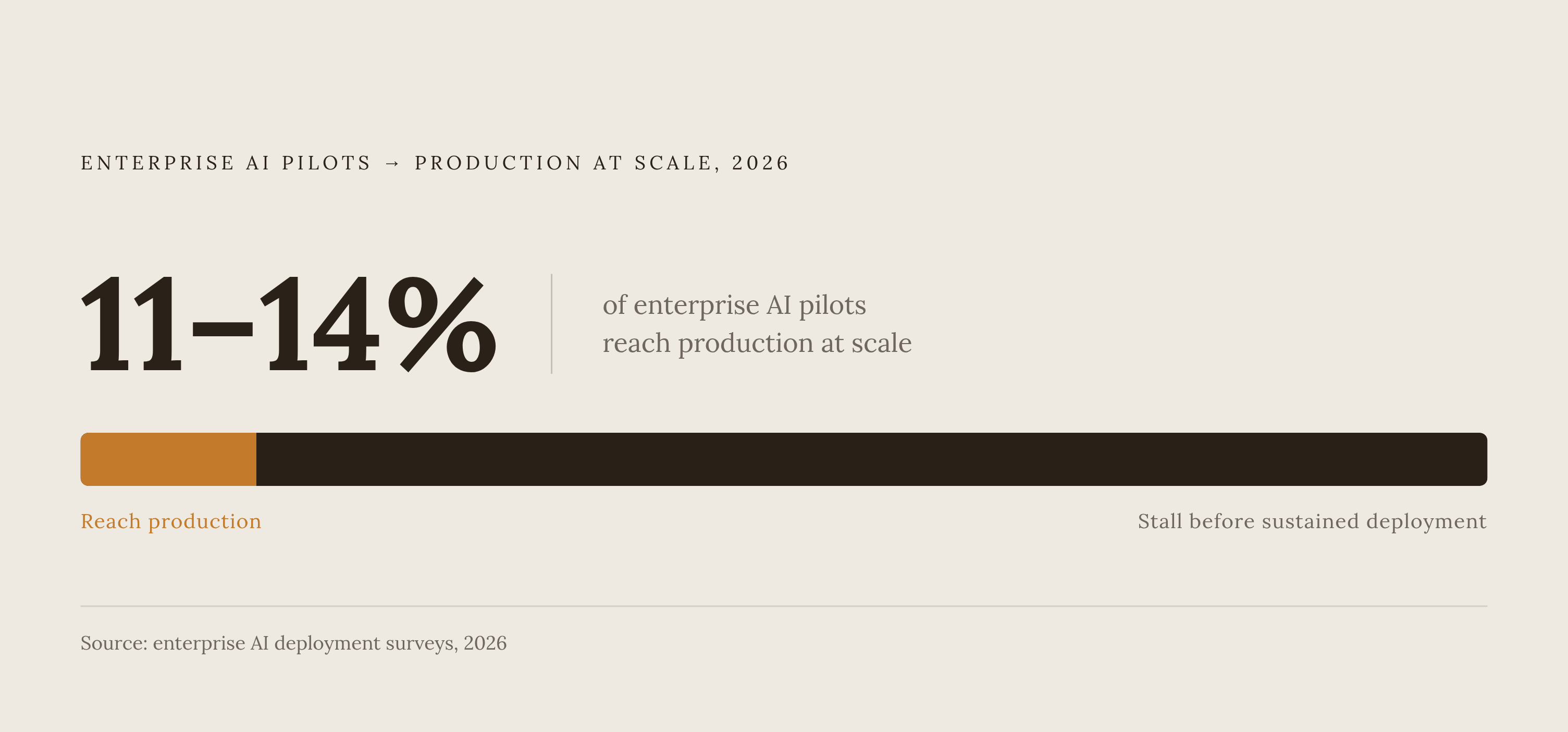
Production also requires tested guardrails, monitoring, access controls, rollback procedures, and defined success metrics. As of 2026, only 11–14% of enterprise AI agent pilots have reached production at scale. That figure concerns enterprise AI broadly. It underscores why the deployment question extends beyond a demonstration of drafting capability to the governance needed for sustained use in a regulated setting. Firms that give AI whole stages, from ingestion through question bank to first draft, can measure how well it does at each handoff while keeping attorney review. That is a different operating model from asking a standalone tool to save time on an occasional task.
Notes
- Building Production-Ready AI Agents in 2026
Provided the statistic that only 11–14% of enterprise AI agent pilots have reached production at scale as of 2026.